Wednesday, May 29, 2019

It's Not Easy Being William Jenkins

The nerds would like to apologize for being among the missing the past several weeks. We were hit with a very nasty illness and we needed some time to recover. Rest assured, we’re feeling much better and what better way to kick off a return than a discussion about 18th-century smuggling!

In previous postings, we’ve alluded to how Newburyport on the eve of the American Revolution was a hotbed for smuggling activities.

Traditionally, the seaside community has always been an ideal location for smugglers to operate from The Merrimack River, as well as the Plum Island and Salisbury coastlines, provided ideal havens for criminals to unload their goods underneath the nose of royal custom officers stationed in the town. Of course, the illicit operations were so successful that by 1766 it caught the attention of Governor Francis Bernard. The leader of Massachusetts Bay Colony was horrified by the reports coming out of Newburyport and ordered Surveyor General John Temple to crack down on the illegal activity. After careful consideration, he turned operational oversight of the crackdown over to William Jenkins.

Jenkins was a “tidewaiter” assigned to the royal custom office in Newburyport. As a tidewaiter, he was responsible for boarding ships that arrived in port and ensuring custom regulations and procedures were strictly followed during cargo inspections. The custom officer readily accepted his assignment and went to work gathering intelligence from the few willing informants he had. He quickly discovered Newburyport smugglers were bringing in illegal goods from two separate locations: the French colonies in the West Indies and St. Petersburg, Russia.

The tidewaiter wasted no time and moved against a Newburyport schooner that was smuggling goods to and from Saint Petersburg. “I have learned from private intelligence that the Schooner which brought in these goods is a common trader to St. Petersburg … She was seized upon an information that She had tobacco on board.” 

Surprisingly, Jenkins did not keep a close watch on the vessel and left it unguarded. A group of Newburyport men quickly boarded the vessel and removed the tobacco before custom officers could seize it. Without any evidence, Jenkins was forced to release the vessel.


The customs officer did not give up and made a second attempt to seize the same ship. On March 9, 1766, the vessel returned from a subsequent voyage to Russia, Jenkins moved singlehandedly to seize the schooner and its cargo. In response, a large group of Newburyport dockworkers and laborers rushed the custom officer, overpowered him, boarded the ship and carried off the illicit goods. As Jenkin’s superior later noted, “After She was discharged She went immediately to St. Peters & returned with a cargo ... Upon this occasion People do not wonder at the goods being rescued, but at an Officer’s being so hardy & foolish (as they say) as to seize them & think he would be able to retain them. Under the present Dominion of the people I have never expected that Any goods, tho’ ever so notoriously forfeited, would be seized, or secured, or prosecuted.”

To his credit, the events of March 9th did not deter Jenkins from trying to stop local smuggling operations. The next day, the customs officer watched as the same schooner engaged in unusual activity between Rings Island and the mouth of the Merrimack River. According to official reports, Jenkins believed there had been “goods landed from said schooner contrary to Acts of Trade.” He gathered several of his men, boarded a batteaux and went to investigate.

Late in the afternoon, Jenkins and his men stumbled across four barrels of sugar and twelve hogsheads and four tierces of molasses hidden on a narrow strip of beach located on the Salisbury side of the mouth of the Merrimack River. He quickly declared the items to be smuggled goods and ordered his men to load them onto the batteaux. 

Little did Jenkins know that he was being watched the entire time by the owners of the seized property.

As the custom officials were loading the batteaux, six boatloads of “armed Men in Disguise” arrived to rescue the goods. They quickly drove Jenkins and his men back, seized the barrels and hogshead and quickly escaped. To add insult to injury, the raiders stole the custom officers’ boat, leaving them stranded on the beachhead. As the sun set, it started to snow heavily. Stranded and facing no hope of rescue until the next morning, Jenkins and his men were forced to huddle together for warmth, “sheltering from a snowstorm as best they could.”

Governor Bernard was quickly informed of the incident by John Temple. Enraged, the governor and his council issued a proclamation seeking the apprehension of Jenkins’s attackers and the recovery the smuggled goods. Bernard even offered a handsome reward of £50 for any information about “these riotous and unlawful proceedings” and a pardon to anyone who might turn king’s evidence. No one in Newburyport came forward.


On March 17, 1766, John Temple upped the ante and added “a reward of 100 dollars” for any information leading to the arrest of Jenkins’ assailants. Although “private intelligence” provided to Jenkins by an informer revealed the comings and goings of a Newburyport vessel trading illegally with the French island of St. Pierre in the Gulf of St. Lawrence, the residents of Newburyport remained tight-lipped about who was behind the March 10th attack on the customs officers.

Monday, April 8, 2019

“Ye Villains! Ye Rebels! Disperse, Damn You! Disperse!” - Four More Myths About the Battle of Lexington

Last week the nerds shared four common misconceptions surrounding the Battle of Lexington and its participants. As we lead up to the annual celebration of Patriot’s Day, here are four more common misbeliefs about the April 19, 1775 engagement.

Captain Parker’s Company was not properly armed and equipped
A common misconception about the Battle of Lexington is that Captain John Parker’s Company was sparsely armed and equipped. Starting in the early 19th Century and well into the 20th Century, paintings, images, historical interpretations and fictional accounts of the Battle of Lexington have depicted the town’s militia company as carrying little to no equipment.

However, a review of period documentation, including primary accounts of the Battle of Lexington, town records and probate inventories show that the Lexington Company actually assembled on the common fully equipped for a military campaign. 

Image by Stephanie Godley

On December 10, 1774, the Provincial Congress declared “The improvement of the militia in general in the art military has been therefore thought necessary, and strongly recommended by this Congress. We now think that particular care should be taken by the towns and districts in this colony, that each of the minute men, not already provided therewith, should be immediately equipped with an effective firearm, bayonet, pouch, knapsack, thirty rounds of cartridges and balls . . . [that], as the security of the lives, liberties and properties of the inhabitants of this province, depends under Providence, on their knowledge and skill in the art of military, and in their being properly and effectually armed and equipped, it is therefore recommended, that they immediately provide themselves therewith; that they use their utmost diligence to perfect themselves in military skill”. When the Massachusetts Provincial Congress issued a resolution regarding the arms and equipment to be carried by its minute and militia companies, Lexington quickly responded. Two days after the Provincial Congress order, the Lexington selectmen ordered the militia to appear at the meeting house for an inspection. During the review, deficiencies in arms and equipment were apparently observed. As a result, the selectmen quickly scheduled a town meeting. On December 27, 1774, the residents reviewed their options and voted to form a committee that would oversee measures to ensure the militia was prepared for war. “Votede . . . That seven persons be appointed as a committee of inspections to see that the plans of the . . .Provincial Congresses are faithfully carriede into executione.”

One of the individuals assigned to the committee was Captain John Parker, commander of the Lexington militia. Over the next several months it appears that this committee took steps to ensure the company was properly armed and equipped. As a result of this effort, several men in Lexington personally contributed to Lexington’s effort to properly arm and equip the town’s militia for war. Jonathan Harrington Sr., the father of company fifer Jonathan Harrington, and Phillip Russell were charged with making cartridge boxes and belting for the militia. Jeremiah Harrington was making tow cloth knapsacks while John Parker was possibly making powder horns for the Lexington Company. Jonas Parker was cutting back gunstocks so fowlers could accept socket bayonets and Nathan Simonds was providing blankets to those Lexington militiamen who could not afford them.

So, did Parker’s Company carry cartridge boxes, muskets, bayonets, powder horns, blankets and packs when it assembled the morning of April 19, 1775? There are several pieces of evidence which support the proposition that it did. 

First, in the aftermath of the Battle of Lexington, thirty-three Lexington militiamen signed a deposition asserting they were “alarmed” and appeared at the company parade. The legal term “alarmed” was a 17th and 18th-century legal term describing a militia’s response to an emergency situation. Under Massachusetts colonial militia laws between 1690 and 1773, when a company was alarmed, they were also required to rally armed and equipped for a military campaign. Second, according to the 1776 anniversary sermon of the Reverend Jonas Clarke, there was a debate over whether the company should dismiss and reform at another location. Clarke also discussed how Parker’s Company was prepared to respond to any military emergency, regardless of the location. “Upon this intelligence, as also upon information of the conduct of the officers as above-mentioned, the militia of ths town were alarmed, and ordered to meet on the usual place of parade; not with any design of commencing hostilities upon the king’s troops but to consult what might be done for our own and the people’s safety; And also to be ready for whatever service providence might call us out to, upon this alarming occasion in case overt acts of violence or open hostilities be committed by this mercenary hand of armed and blood thirsty oppressors.”

There is also the official correspondence from Lt. Colonel Francis Smith. In his report to General Thomas Gage regarding the events of April 19th, the expedition commander specifically states the Lexington militia was drawn up in military order, armed and fully equipped. “I think it proper to observe, that when I had got some miles on the march from Boston, I detached six light infantry companies to march with all expedition to seize the two bridges on different roads beyond Concord. On these companies' arrival at Lexington, I understand, from the report of Major Pitcairn, who was with them, and from many officers, that they found on a green close to the road a body of the country people drawn up in military order, with arms and accouterment, and, as appeared after, loaded.”

Finally, there the petitions from several Lexington men or families who described how British troops looted the dead and wounded of their arms and equipment in the aftermath of the skirmish. John Tidd submitted a petition to the Massachusetts Legislature in early 1776 claiming that after he was wounded at the Battle of Lexington, British soldiers robbed him of his arms and equipment. “Petition of John Tidd of Lexington setting forth that on the 19th of April he received a wound in the head (by a Cutlass) from the enemy, which brought him (senceless) to the ground at wch time they took from him his gun, cartridge box, powder horn &c.” Likewise, Benjamin Wellington and two other individuals submitted claims that stated “Petition of Benja Wellington, & others of Lexington, setting forth that they sustained the aforementioned losses by the Kings troops on the 19th of April 1775 viz: Benja Wellington, a gun, bayonet, &c. … Jno Muzzy, a gun, powder horn, &c. Taken from his son … Lucy Parker, a musquet, &c. Taken from her husband … Marrit Munro, a gun & hat taken from him.”

There were very few spectators present at the Battle of Lexington.

One important aspect of the Battle of Lexington that has been often overlooked by historians is the psychological and physical impact upon the civilian populace. David Hackett Fisher argues in his work, Paul Revere’s Ride, that a large number of spectators from Lexington and nearby towns gathered along the edge of the town common to watch how the events would unfold. Unfortunately, Fisher’s assumption is most likely incorrect.

When Lexington’s alarm bell began to toll in the early morning, most residents recognized that a hostile military force was marching directly towards them. With the possibility of the town being subjected to plunder and destruction, a panic set in. Many who lived along the Boston Road prepared to evacuate. Anna Munroe, wife of Sergeant Munroe, started to bake bread for her husband. Later she confessed, “I mixed my bread last night with tears coming, for I feared I should have no husband when the next mixing came.” The Reverend William Gordon of Roxbury noted “the inhabitants had quitted their houses in the general area upon the road, leaving almost everything behind them, and thinking themselves well off in escaping with their lives.” Some escaped with a few select belongings. Others quickly hid or buried valuables before leaving. One 19th century Lexington account suggested many residents “hid their silver and mirrors and many other things in [a] swamp. The Reverend Clarke's family hid “money, watches, and anything down in the potatoes.” Captain Parker’s wife, Lydia, “took all the valuables and hid them in a hollow trunk of a tree standing some distance from the house.” Lydia Mulliken and her daughters, who lived along the Boston road, heard the alarm and hurriedly buried the family’s silver and other valuables by a stone wall near their clock shop, then fled to distant safety. Mary Sanderson gathered her children and “taking such articles as they could hurriedly collect and carry in their arms, by the light of a lantern [made their way] to a refuge, the home of her father in New Scotland.” The Loring daughters scurried to hide the communion silver in a brush heap back of the house before fleeing.

Ralph Earl, The Battle of Lexington, April 19th, 1775, etched by Amos Doolittle

For some women, the flight was particularly difficult. Four women, Sarah Marrett, Amity Pierce, Sarah Reed and Betty White, were still likely bedridden having given birth over the past month. Sarah Reed and her newborn child had to be carried out her home on a mattress by her husband and in-laws. Three others, Dorcus Parker, Elizabeth Estabrook and Lydia Harrington, were all over eight months pregnant. Other women rushed to get their young children to safety. Abigail Harrington, took her toddlers “down a lane back of the house across a meadow to the old place on Smock farm.” Anna Munroe fled from the family tavern with her three young children and hid on a hill behind the establishment.

Several Lexington militiamen in later accounts recounted how they passed the time waiting for the regulars by taking shelter in vacated homes along the Green.

Thus, most of Lexington's women and children who resided along the Bay Road were likely long gone and out of the way by the time Major Pitcairn arrived in Lexington.

However, this is not to say there were no spectators. Instead, period accounts suggest there was a small smattering of spectators who witnessed the battle. Local tradition suggests that the wife of Jonathan Harrington, who was killed in the engagement, was too ill to evacuate and observed the battle from the second floor of her home. Thomas Rice Willard watched the battle from a window in Daniel Harrington’s house, also located at the back of the Lexington common. William Draper, a resident of Colrain, Massachusetts who happened to be in Lexington on April 19th watched the battle from an unknown location. Finally, Thomas Fessenden asserted that as he stood in a pasture, he watched the regulars enter the common and rush the training band “at about half an hour before sunrise.”

There were Loyalists present at the Battle of Lexington.

Wait … what?

When Smith’s expedition departed from Boston, present with the column were the Loyalist guides who either volunteered or were recruited to assist the mission to Concord. Little has been written about the role Loyalists played in Gage’s military operation. A review of primary sources, including Loyalist claims for compensation after the American Revolution, suggests that at least six loyalists were recruited to assist Lieutenant Colonel Smith’s expedition by navigating colonial roads and assisting troops in locating military stores in Concord.

Among the guides were former Harvard classmates and friends Daniel Bliss of Concord and Daniel Leonard of Taunton. Both were well established attorneys who were forced to flee to the safety of Boston in 1774. It was suspected by many Massachusetts Loyalists that Leonard was the anonymous author “Massachusettensis”, who had published a series of pro-government letters drafted in response to the political arguments of John Adams.

Dr. Thomas Boulton of Salem and Edward Winslow Jr. of Plymouth also volunteered for the mission. Boulton was a vocal supporter of Crown policies towards Massachusetts and was forced to flee to Boston in 1774. Winslow held several political and legal posts in Plymouth County. Sensing a radical shift in the political mood in October of 1774, he abandoned his estate and also retreated to Boston.

Another Loyalist was William Warden. Warden was born in Boston and was a shopkeeper, grocer and barber. Unlike many of his station, Warden had been opposed to the political and violent activities of the Massachusetts “patriots” since the Stamp Act. 

Image Courtesy of McAlpin's Corps of American Volunteers

It appears the guides were interspersed throughout the column. Lieutenant William Sutherland of the 38th Regiment of Foot references on two separate occasions a “guide” attached to the front of the column. “When I heard Lieut. Adair of the Marines who was a little before me in front call out, here are two fellows galloping express to Alarm the Country, on which I immediately ran up to them, seized one of them and our guide the other, dismounted them and by Major Pitcairn's direction gave them in charge to the men.” In a separate letter, Sutherland describes how a Loyalist guide identified a captured American prisoner as being a person of importance. “I mett coming out of a cross road another fellow galloping, however, hearing him some time before I placed myself so that I got hold of the bridle of his horse and dismounted him, our guide seemed to think that he was a very material fellow and said something as if he had been a Member of the Provincial Congress.”

When the British light infantry stepped onto the Lexington Green the morning of April 19, 1775, at least one to two loyalist guides were with them. In his petition for compensation to the British Government at the end of the Revolution, loyalist Edward Winslow Jr. asserted he was with the 4th and 10th Regiments of Foot when they advanced on Captain Parker’s Company. Another loyalist suspected of being at the head of the column was Concord attorney Daniel Bliss.


The British Troops and Captain Parker’s Company were not in a standoff.

Most modern depictions of the engagement, including the movie April Morning, depict a brief but tense standoff between both sides before a mysterious shot is fired and the skirmish begins. However, in reality, the entire skirmish was over in less than five minutes.

As the British column closed in on Lexington’s common, a British sergeant reported that a party of colonial horsemen rode out from the village and shouted, “[you] had better turn back, for you shall not enter the town!” One of the mounted men then “presented a musquet and attempted to shoot them, but the piece flashed in the pan.” According to Lieutenant Sutherland, another individual fired at him from the vicinity of Buckman’s Tavern. He reported this to Pitcairn who then galloped to the front of the column, halted the men and ordered them to load their muskets and fix bayonets. “On this, I gave directions to the troops to move forward, but on no account to Fire, or even attempt it without Orders.”

William Sutherland noted “shots fired to the right and left of us, but as we heard no whissing of balls, I [concluded] they were to Alarm the body that was there of our approach.” Off in the distance, militiamen could be seen hurrying into line. “The road before you go into Lexington is level for about 1000 yards . . . when we came up to the main body which appeared to me to Exceed 400 in and about the village who were drawn up in a plain opposite the church.”

Captain Parker’s men waited nervously for the arrival of the British regulars. As the troops approached, many began to realize the danger they were in. One was bold enough to tell Parker “There are so few of us! It is folly to stand here!” The militia captain, ignoring the outcry, turned to his company and stated “Let the troops pass by, and don't molest them, without they begin first.”

Pitcairn was confronted with a military quandary. If he chose to ignore the militia company drawn up on the village common, he would be leaving an armed opponent to his rear. If he halted, he could exacerbate an already tense situation.

The light infantry officers in the lead company of the column, the 4th Regiment of Foot, resolved Pitcairn’s dilemma by directing their men towards the Lexington militia. The next regiment, the 10th Regiment of Foot, quickly followed. The two lead companies raced towards the increasingly nervous militia. Suddenly, they deployed into a line of battle, continued their rapid advance and began to shout “Huzzah!” Pitcairn, realizing the situation was getting out of hand, “instantly called to the soldiers not to fire, but rather to surround and disarm the militiamen.” Many of the excited troops and officers may never have heard this order as they continued to shout and yell. Lieutenant Edward Gould of the 4th Foot later testified that he could not hear above the noise his men were making.

Image from Hallmark's movie April Morning

Pitcairn and other officers then rode towards Captain Parker and his men. According to Sutherland, several officers began to shout, “throw down your arms and you shall come by no harm, or words to that effect.” Private James Marr of the 4th Foot believed Pitcairn exclaimed, “Stop you rebels!” However, many of the Lexington militiamen later asserted that the officers shouted “Lay down your arms, Damn you, why don’t you lay down your arms?” Militiaman John Robbins, who was in the front rank as the regulars approached, recalled the officers chastised the militia by stating, “Throw down your arms ye Villians, ye Rebels!” Spectator Thomas Fessenden heard an officer order “Disperse you rebels, immediately.” Jonas Clarke, believed he heard an officer demand “Ye villains! Ye rebels! Disperse, damn you! Disperse!”

Recognizing the situation was becoming more and more dangerous, Parker turned to his men and issued new orders. “I immediately ordered our militia to disperse, and not to fire.” Most of the men obeyed his command and began to file off the common. Some, however, either did not hear Parker’s order or chose to ignore it. As a result, several Lexington men held their ground as the light infantry surged forward.

Suddenly, a single shot rang out and the rest is history.

Monday, April 1, 2019

"To Be in Constant Readiness for Action" - Addressing Some of the Myths Surrounding the Battle of Lexington

Yesterday, the nerds had the opportunity to observe the annual dress rehearsal of the Battle of Lexington reenactment. Thankfully, the public interpreters did a wonderful job educating the public about the facts and circumstances surrounding the opening engagement of the American Revolution.

Naturally, this inspired us to address some of the more common myths surrounding the engagement. Without further delay, here is the first batch of common misconceptions and myths we’ve encountered over the years!


The Men Who Stood on the Green Were Called "The Lexington Minute Men”

Lexington’s militia was not known in 1775 as the “Lexington Minute Men”. Available research suggests a formal minute company had yet to be established by April 1775. According to period accounts, including the correspondence from the Reverend William Gordon, the Lexington militia was only divided into two bodies formally known as the Training Band and Alarm List. On the other hand, a minute company simply did not exist in Lexington.

However, depositions from some of the Lexington militiamen in the aftermath of the Battle of Lexington informally referred to their town militia not as the Lexington Training Band, but as “Captain Parker’s Company”. On April 25, 1775, Simon Winship stated the British troops “marched on till they came within a few Rods of Captain Parkers Company.” A day earlier, John Robbins asserted “that on the Nineteenth Instant, the Company under the Command of Captain John Parker, being drawn up (sometime before sun Rise) on the Green or Common.” William Draper stated “I, William Draper, of lawful Age, and an Inhabitant of Colrain, in the County of Hampshire, and Colony of Massachusetts Bay, in New England, do testify and Declare, that, being on the Parade of said Lexington, April 19th Instant, about half an hour before sunrise, the King's Regular Troops appeared at the meeting House of Lexington. Captain Parkers Company, who were drawn up back of said meeting house on the Parade, turned from said Troops, making their escape, by dispersing; in the meantime, the Regular Troops made an huzza, and ran towards Captain Parkers Company.” 


Surprisingly, a third name, “Lexington Company”, was also utilized by the town’s militiamen. In other depositions immediately following the Battle of Lexington, no less than five Lexington men refer to their unit as “The Lexington Company”. “I, Elijah Saunderson, above named, do further testifie and declare, that I was on Lexington Common, the Morning of the Nineteenth of April, aforesaid, having been dismissed by the Officers above mentioned, and saw a Large Body of Regular Troops advancing toward Lexington Company.” According to Benjamin Tidd, “the regulars fired, first, a few guns, which we took to be pistols from some of the Regulars who were mounted on Horses, and then the said Regulars fired a Volley or two before any guns were fired by the Lexington Company.”

Thus, all three names are proper references to the militia unit that fought at the Battle of Lexington.  Unfortunately, the "Lexington Minute Men" term is not one of them.


Captain John Parker Was a Veteran of the French and Indian War

Captain John Parker was the commanding officer of the American militia at the Battle of Lexington. Family tradition credits Parker with considerable military experience prior to the Revolution. It is claimed that he was present at the capture of Louisburg, served during the French and Indian War, fought in Quebec in 1759, and was a member of Roger’s Rangers.

So, did John Parker actually have military combat experience before April 19, 1775? The answer is a resounding NO.

The first time someone claimed John Parker was a veteran of the French wars was in 1893, one hundred and eighteen years after the Battle of Lexington. That year two separate publications asserted Parker had combat experience. The first was written by his grandson, the Reverend Theodore Parker. In his work Genealogy and Biographical Notes of John Parker of Lexington and His Descendants: Showing His Earlier Ancestry in America from Dea. Thomas Parker of Reading, Mass., from 1635 to 1893, the Reverend Parker states “John Parker was at the capture of Louisburg in 1758... was at the taking of Quebec in 1759 . . . [and was] made a sergeant in this war.” A second publication by Captain Parker’s great-granddaughter Elizabeth S. Parker alleged the militia captain “had served in the French and Indian War.” 


Over the next several decades, historians were quick to promote these questionable claims. Unfortunately, there are no official records, journals or surviving artifacts to support the proposition John Parker enlisted in the war effort against the French, let alone saw combat.

One claim occasionally advanced by 20th-century historians is that Parker’s father Josiah served at the 1745 Siege of Louisbourg as an officer. In turn, he must have brought his then fifteen-year-old son John along as a servant. This assertion is nothing more than bunk. There are no records that Josiah Parker enlisted in the Louisbourg expedition. In fact, town records from the period clearly establish that Josiah Parker was in Lexington and actively serving as a selectman in 1745.

Likewise, a review of marriage, baptismal, personal, town and military records all demonstrate that John Parker was also present in Lexington during the French and Indian War. On May 25, 1755, Parker married Lydia Moore in Lexington. In early Spring of 1756, Lydia became pregnant. According to Parker’s own account book, he was satisfying woodworking orders in Lexington during the month of August 1757. She gave birth to a baby girl on November 8th. In the summer of 1758, Lydia became pregnant for the second time and gave birth to a baby girl on January 11, 1759.

While Provincial and Regular troops were laying siege to Quebec, Parker was in Lexington. In June 1759, Benjamin Reed noted that he assembled his militia company and issued bayonets to some of his men. John Parker was one of them. “The following names are a full and Just account of those to whom I the Subscriber delivered Bayonets in the company under my command in Lexington, Benjamin Reed, Captain, June 5, 1759… [49 militiamen listed including John Parker].”

Each of these events occurred after the commencement of a seasonal military campaign. If Parker enlisted with a Massachusetts provincial regiment, he would have embarked in April or May with his regiment for either the New York frontier or Nova Scotia. He would not have returned to Lexington until late November. Unfortunately, he could not have been in two places at once.

However, the fact that John Parker lacked military experience should not take away from his accomplishments immediately following his defeat at the Battle of Lexington. Parker successfully rallied his company and mobilized them for war. Less than twelve hours later, he successfully staged a devastating ambush against a retreating British column. This action alone should put to rest any doubt regarding the military skills of John Parker.

Captain John Parker’s Company Was Not Properly Trained for War

Unfortunately, a very common misconception about Captain John Parker’s Company is that the unit was poorly trained and put little to no emphasis on wartime preparation. This could not be further from the truth. 


Under the guidance of the Reverend Clarke, the town was on a wartime footing as early as 1768. Six weeks before the October 26, 1774 resolves of the Massachusetts Provincial Congress calling for wartime readiness, the Lexington militia was already “training” and “showing arms”. Other accounts suggest that the Lexington men were constantly drilling. According to William Tidd, “said company frequently met for exercise, the better to be prepared for defense.” Likewise, John Munroe recalled, “ the company was frequently called out for exercise, and desired to furnish ourselves with arms and ammunition, and to be in constant readiness for action.”

Lexington’s attention to military detail naturally caught the attention of Pitcairn’s officers when they stepped onto the Lexington Green. The British commander of the expedition to Concord, Lt. Colonel Francis Smith, later reported that his officers noted Parker’s Company was “drawn up in military order”. Ensign Henry De Berniere of the 10th Foot, described the Lexington men drawn up in two “divisions”, with a company-wide space between the two. Ensign Jeremy Lister recalled, “it was at Lexington when we saw one of their Comps drawn up in regular order.” Interestingly enough, Major John Pitcairn claims to have observed the militia company attempt to leave the Green by using the complicated light infantry maneuver of retiring by files. “I observed drawn up upon a Green near 200 rebels; when I came within about 100 yards of them, they began to file off towards some stone walls on our right flank.”

Thus, period accounts clearly establish John Parker and his officers were taking the necessary steps to ensure their men were properly trained for war.

Lexington Had a Cannon on the Eve of the Battle of Lexington?!?

Surprisingly, this myth is true! 

In late 1774, as wartime preparations started to ramp up, many Massachusetts towns were scrambling to obtain artillery pieces. Some of the guns, mostly iron cannons, were taken from coastal defenses around Boston and sent to Watertown.

Two of the guns caught the attention of Lexington. Its residents quickly pressed the selectmen to acquire a pair of cannons for the town. On November 3, 1774 a petition was submitted to “see if the Town will fetch two small pieces of cannon from Watertown, offered by said Town for the use of the Company in this Towne.” A week later, the town approved the purchase of two gun. “Voted. . . to bring the two pieces of Cannon (mentioned in the warrant) from Watertown & mount them, at the Town charge.” 


After approving the purchase of two cannons, in true Yankee fashion, the residents voted to create a committee to explore the cheapest methods of mounting of the guns on carriages and building of ammunition boxes. “Voted . . . That a Comtee of three persons go to Watertown & see what the cost of mounting sd pieces will be & whether the carriages cannot be made by work men in this town . . . Captain Bowmane, Mr. Jonas Parkere & Ensign Harrington . . . Be a Comtee for the sd. Purpose.”

At some point after November 28, 1774, it received the two guns from Watertown. “Voted . . . that the Selectmen receive the two pieces of cannon with their beds of the Towne of Watertowne and give receipts for the same on behalf of the Towne . . . that a committee of three persons be chosen to get the saide pieces well mounted & as cheap as they can. . . Voted . . . £40 for the purpose of mounting the cannon ammunition.” 

By late February 1775, Thomas Robbins of Lexington was already making ammunition cartridges for the guns. On February 27th, the town “Granted an ordere to pay Mr. Tho Robbins 1/9 in full for his trimming the Bales (balls?) & providing baggs to put them in.”

Unfortunately, what became of the guns after February 1775 is unknown. Lexington’s town meeting minutes from the Spring of 1775 were stolen years ago. Records from December 1775 through the remainder of the war do not mention the cannons. Likewise, there are no period accounts suggesting that the pair of guns were used at the Battle of Lexington.


Shortly after the War for Independence, Lexington formed an artillery company. Whether the guns used were the same ones acquired from Watertown in 1774 remains a mystery.


Join us later this week as the nerds continue to address even more misconceptions surrounding the Battle of Lexington and its participants!


Sunday, March 10, 2019

Eight Cool Artifacts With Ties To 18th Century Newburyport

When the nerds aren’t salivating over all things Lexington and Concord, we’re usually exploring the history of 18th and early 19th Century Newburyport. The seaside community has a unique and special history that includes shipbuilding, rum, privateers, Benedict Arnold and the very eccentric Lord Timothy Dexter.

Recently, we decided that we wanted to share eight cool artifacts from the 18th century that have direct or indirect ties to Newburyport. While a couple of these items bore witness to the American Revolution, the remainder are local in nature and provide a snapshot of life in the seaport town.

Without further delay, here are eight very cool, but little known, artifacts from the Newburyport area!

Wedding Dress (Museum of Fine Arts, Boston, MA). This wedding dress was worn by Newbury’s Mary Beck in her marriage to Nathaniel Carter on September 1, 1742. The dress is made of silk and has various floral patterns in green, blue, yellow, pink and violet colors. 


The Becks were a prominent merchant family from the Waterside District of Newbury and in the early 1760s advocated for the district to form a separate town. Ultimately the movement was successful and Newburyport was created. On January 28, 1764, the General Court of Massachusetts permitted the separation and passed "An act for erecting part of the town of Newbury into a new town by the name of Newburyport." According to the resolution “Whereas the town of Newbury is very large, and the inhabitants of that part of it who dwell by the water-side there, as it is commonly called, are mostly merchants, traders, and artificers, and the inhabitants of the other parts of the town are chiefly husbandmen; by means whereof many difficulties and disputes have arisen in managing their public affairs – Be it enacted ... That that part of the said town of Newbury ... be and hereby are constituted and made a separate and distinct town.”


Nichols and Coffin Fire Buckets (Custom House Maritime Museum, Newburyport, MA and Private Collection). A fire bucket was typically made of leather and used to fight fires. Pursuant to Massachusetts colonial and state laws well into the 19th Century, every home was required to have one fire bucket per occupant. If there was a fire, all town residents were required to turn out with their buckets and form human chains between a water source and the fire. Residents would then toss water from the buckets onto the fire until it was extinguished. Afterward, it was common for residents to simply toss the buckets into a large pile. Fire buckets, like modern lobster trap buoys, were often decorated with unique colors, patterns, and designs so that could owners identify and claim their buckets. 

These particular fire buckets belonged to a pair of prominent Newburyport families and date to the 1770s.


Portrait of a Man in a Blue Jacket (Private Collection). "Portrait of a Man in a Blue Jacket, a Member of the Perkins Family, Newburyport, Massachusetts" by Benjamin Blyth (1746–1787). Benjamin Blyth was born in Salem, Massachusetts, in 1746 and was one of the best known and most successful portraitists on the Massachusetts North Shore from the mid-1760s through the early 1780s. He found a ready clientele amongst wealthy shipowners and merchants and his depiction of Captain John Somes and his wife Anna, currently at the Cape Ann Museum, is typical of his work. 

This particular item depicts a member of the Perkins Family from Newburyport. It was auctioned by Skinner, Inc. on November 3, 2018 and sold for $1046.00. 


Painting of the Thorn (Private Collection). The HMS Thorn was built in Mistley, England and launched on February 17, 1779. She weighed over 305 tons, had eighteen guns, was coppered along the hull bottom and pierced for eighteen guns. Unfortunately, service in the Royal Navy was short lived as the ship and crew were captured by two American naval frigates on August 25,1779. She was towed back to Boston and sold as a prize to Isiah Doane. The vessel was quickly outfitted and re-launched as the Privateer Thorn on November 11, 1779. On April 5, 1780, Newburyport’s Nathaniel Tracey purchased the Thorn. While serving as a Newburyport privateer, the Thorn was very successful in disrupting British supply lines. Unfortunately, she was re-captured in August of 1782. The Thorn remained in the service of the Royal Navy until 1816. Afterward, the ship was sold to the Marine Society of London to serve as a training vessel.

In 1797, British artist George Owen created a series of watercolors, including one of the Thorn, for a naval publication. Although this image was drawn a little over a decade after the American Revolution, it is the only known drawing of a Newburyport privateer from the American Revolution. This image, as well as three companion drawings, were sold at auction 
on January 26, 2017, to a private collector.


John and Dorothy Hancock’s Chariot (The Dorothy Quincy Homestead, Quincy, MA). On January 21, 1778, John Tracy and others presented to John Hancock an elegant chariot that was taken from a British vessel captured by the Newburyport based privateer “Civil Usage” the previous year. According to a newspaper account found by Boston 1775’s John Bell, the March 11th Pennsylvania Ledger, noted that “John Hancock of Boston appears in public with all the pageantry and state of an Oriental prince. He rides in an elegant chariot, which was taken in a prize to the “Civil Usage,” a pirate vessel, and by the owners presented to him. He is attended by four servants, dressed in superb livery, mounted on fine horses richly caparisoned, and escorted by fifty horsemen with drawn sabres, the one half of whom precede, and the other follow, his carriage.”

In the 19th Century, the owners of the chariot removed the vehicle's wheels and installed runners, thereby making it a horse-drawn sleigh. It is currently in the possession of the Dorothy Quincy Homestead in Quincy, Massachusetts.


Gout Stool (Museum of Old Newbury, Newburyport, MA). Gout is a form of inflammatory arthritis caused by the crystallization of uric acid in joints. The joint at the base of the big toe is most commonly affected, and the pain caused can be excruciating and recurrent. A gout stool elevates the afflicted foot to provide some relief. In the 18th century, diet and a sedentary lifestyle were seen as the chief causes of the disease. Though these factors are important, today we know that others, like family history and chronic illnesses, can also be to blame. Ben Franklin suffered from gout, and in 1780 penned a comic essay of an imagined conversation between himself and “Madam Gout.”

This particular stool is hinged, allowing it to be adjusted to the most effective position. It dates to the mid-18th Century and is in the possession of the Museum of Old Newbury.


Joseph Little Hatter’s Sign (Private Collection). Joseph Little was born in 1730, married Elizabeth Hazen and worked as a hatter in Newburyport until his death in 1792. He also served as a private in the Continental Army during the American Revolution. Joseph Little’s older brother was Col. Moses Little (1724-1798) a captain of the local company of Minutemen that marched in response to the Lexington-Concord Alarm of April 19, 1775.

This trade sign caused quite a stir in 2017 when it was listed for sale on eBay for a mere $25000. The rare wooden trade sign displays a cocked hat, the date 1762, Little’s name and his occupation of “hatter”.

The sign was in the custody of the Rhode Island School of Design and the Daphne Farago Collection of Americana and Folk Art until it was sold at auction by Sotheby’s in 1991. It was owned by a private collector in Philadelphia until 2017 when he sold it on eBay. Its current location is unknown.


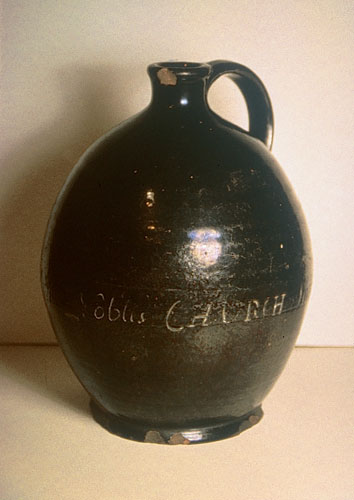
Communion Jug (Old York Museum, York, ME). This communion jug is attributed to Daniel Bayley of Newburyport and is dated to c. 1763. According to the Old York Museum, “this jug—one of the earliest dated pieces of American redware—was used to store wine for communion services at the Fifth Parish Congregational Church of Newbury, headed by Reverend Oliver Noble. It is the only documented example of eighteenth-century ecclesiastical redware produced in New England.” On one side it is inscribed with the name “Daniel Bayley”. On the other it is marked “For the use of Mr. Noble’s CHURCH July 10, 1763.” 


Know of any other cool 18th and early 19th Century artifacts from Newburyport we should be highlighting? Be sure to let us know!

Tuesday, February 19, 2019

"A Wooden Bottle Made With One Hoop" - Why Tin Canteens Were Not Carried By Massachusetts Militia Men at Lexington and Concord

Over the past several years the nerds have received multiple inquiries regarding whether or not tin canteens were used by Massachusetts militia and minute companies at the outbreak of the American Revolution. At first, we naturally assumed that these water containers would have been readily available as they were issued to Massachusetts Provincials fighting in the French and Indian War. However, the more we examined the matter, the more we were convinced that tin canteens were most likely not utilized by Massachusetts forces on April 19, 1775.

The first thing we noticed in our research was as early as 1746, tin canteens were referred to as "flasks" and "tin flasks" rather than “canteens”.  
Of course, the tin industry was almost non-existent in mid-18th Century New England and as a result, Massachusetts officials were heavily dependent upon England to deliver tin flasks to the colony.  


During the French and Indian War, English supply lines were sporadic and occasionally non-existent. Thus, there is a gradual evolution by the Massachusetts legislature to supply only wood canteens or “wood bottles”. At first, colonial officials recommended troops be supplied with tin flasks or “wooden bottles”.  However, by 1758-1759, the Massachusetts legislature had entirely ceased recommending tin flasks and ordered provincial soldiers be supplied with “a wooden bottle made with one hoop ... or a Canteen". 

Understandably, some researchers will argue the legislative term “canteen” is a continued reference to tin canteens. Respectfully we disagree. Given the legislature’s shift to wood water vessels in 1758, we believe the term “canteen” was a possible reference to wooden staved canteens.


That said, we do want to mention that a limited amount of tin flasks were issued to Massachusetts provincial troops during the French and Indian War. At least 1000 tin flasks (ie canteens) from England were disbursed to Colonel Thomas Doty's Regiment in May 1758. According to the "Account of Warlike Stores deliver'd Col., Thomas Doty's Regiment" the unit received "...1000 flasks, 183 Tin Kettles." It should be noted that this report of equipment issued surfaced in a Boston newspaper after Colonel Doty publicly claimed his regiment never received weapons, canteens, and accoutrements.

So assuming that at least 1000 tin canteens were in the hands of provincials in 1758, the next question is whether they remained in serviceable condition to be of any use in 1775?


During the French and Indian War, the British government was not sending its best arms and equipment to the American colonies. Many provincial soldiers and colonial officials repeatedly complained about the quality of supplies they received. In 1756, Virginia’s Lieutenant Governor Robert Dinwiddie complained about a shipment of arms and equipment that was received and slated to be shared amongst the American colonies, including Massachusetts. According to Dinwiddie, the stands of arms were “in a very rusty condition, and it w’d appear they had been underwater for months.”

The previous year, on September 28, 1755, Governor Shirley and Major General William Pepperrell both received correspondence highlighting the inadequacies of weapons and equipment sent to Massachusetts provincials. “The locks being wore out and the hammers so soft, that notwithstanding repeated repairs they are most unfit for service, particularly Sir William Pepperrell’s Regiment being old Dutch arms. The holes of the pouches and boxes are so small that they cannot receive the Cartridge, nor is there substance of the wood, to widen them sufficiently. The leather scanty and bad likewise.”

Given the above, we suspect tin canteens issued from England were also of poor quality and would not have survived a hard military campaign season, let alone twelve to seventeen years of service on a New England farm before being used on April 19th.

However, to cover all bases, we returned to the Massachusetts legislative records and examined petitions for compensation for property, destroyed or lost at the Battles of Lexington and Concord and the Battle of Bunker Hill. There are NO claim or request for compensation for lost tin flasks or tin canteens. We also examined available returns and orders for Massachusetts minute and militia companies immediately before or after Lexington and Concord. While we have uncovered references to "wooden bottles" we have not found a specific reference to “tin flasks”.

Finally, we examined merchant advertisements from Boston, Salem and Newburyport between 1770 and 1776. Unfortunately, we could not find a single advertisement for tin flasks or tin canteens.

As a result, we’re of the opinion tin canteens were not utilized by Massachusetts militia and minute companies at Lexington and Concord.

Of course, if you know of any available documentation that challenges our theory, please let us know! We’d love to get your thoughts on the issue!

Friday, February 8, 2019

Naked Weddings, Kidnappings and Running the Bottle - Weird Wedding Practices in 18th Century New England

Admittedly, the Nerds might have had one beer too many during a recent visit to Brewery Silvaticus as we started talking about unusual wedding customs in 18th and early 19th Century New England. Here’s what we found.

In Newburyport and other Massachusetts seaport communities, there was the tame tradition of the bridal party walking in procession through the town following the marriage ceremony. (The bride was commonly referred to as the "walking-out bride".) In other New England communities, an elaborately dressed bride and groom would occupy a prominent seat in the gallery of the meetinghouse on the Sabbath after their wedding. At some point, they would be called upon by the minister to stand up and model every side of their wedding finery. Often the bride would be allowed to select the text of the sermon preached. In 1764, Abigail Smith Adams, with the help of her father, selected the biblical text, "John came neither eating bread nor drinking wine, and ye say he hath a devil."


Of course, not all wedding traditions were so mild. In Londonderry, New Hampshire, residents took the celebration of marriage one step further and introduced the British sport of "riding for the kail” or "riding for the ribbon". Period accounts suggest the wedding festivities began when the groom's friends would gather at his home, arm themselves with muskets and march towards the bride’s residence. Along the way, the party would discharge their guns at every house they passed. Eventually, they would meet up with a party of the bride’s male friends. Each group would then choose a champion to "run for the bottle" at the bride's home.

The event typically involved a horse race at breakneck speed through half-cleared roads to the home of the bride. The first to arrive would secure a beribboned bottle of whisky and race back to his companions with the prize.

Following the race, both groups, as well as the bridal party, would then proceed to the wedding venue. As they passed through certain neighborhoods, hidden groups of men would discharge blank cartridges at the party. In other neighborhoods, trees were felled or grapevines stretched across the roadway to delay the bridal festivities.

Upon reaching the wedding venue, the bridegroom and his party of friends entered a room and remained there until the best man escorted the bride to the gathering. The best man and a male bridesmaid would then station themselves behind the bridal couple. Afterwards, the ceremony would start.

And yes - at the end of the ceremony, the beribboned bottle of whiskey was usually consumed.

In other New England towns, a common custom was to kidnap the bride in the midst of the wedding ceremony. Typically, a group of young men who had not been invited to the ceremony would crash the party and drag away the bride. In turn, the groom and his companions would pursue the kidnappers and rescue the bride by providing dinner to the culprits. In the town of Charlestown, Rhode Island, one account describes how a group of young men went to the home of a bride in the middle of the night, pulled her out of bed, and carried her downstairs. When the raiders found the front door locked, they beat it down with an axe and disappeared into the night with her.

A similar custom existed in Connecticut but involved the groom trying to escape from the wedding. According to a 1704 account by Sarah Kemble Knights, “They generally marry very young; the males oftener, as I am told, under twenty than above, they generally make public Weddings, and have a way something Singular (as they say) in some of them, viz., just before joining hands the Bridegroom quits the place, who is soon followed by the Bridesmen, and, as it were, dragged back to duty - being the reverse to the former practice among us to steal Mistress Bride.”


Yet another unique New England wedding custom was the “smock marriage”. Colonial legal scholars often argued that if a widow only wore a shift at her wedding, then her new husband would escape liability for any debts owed by her or by her deceased husband.

In 1724, the Town of Westerly, Rhode Island recorded several smock weddings. In 1789, Moses Joy married the widow Hannah Ward in Newfane, Vermont. According to one witness, the bride stood inside a closet naked and extended her hand to her husband through a hole in the door. An early 19th-century account from Westminster, Vermont, noted that the “widow Lovejoy married Asa Averill” while nude and standing in a chimney recess behind a curtain. In York, Maine the widow Mary Bradley met the bridegroom on the highway, “halfway from her home in February while only clad only in a shift”. When the minister arrived, he quickly threw his coat over the shivering bride and performed the ceremony.

We’ll keep our eyes open for any other period accounts of unusual wedding practices. If we come across any additional information, we’ll be sure to post it here.

In the meantime, be sure to support our friends at Untapped History and vote for them as the 2019 Best Tourist Attraction on the Northshore!

Sunday, January 27, 2019

"MURDERED By The King’s Troops" - The Looting of Lexington Dead and Wounded After the Battle

Last week, we discussed the lack of haversacks amongst Massachusetts militia in 1775.  During our discussion, we referenced the Acts and Resolves, Public and Private, of the Massachusetts Bay. These legislative records are available online and are a treasure trove of information. 

Not surprisingly, the records contain claims submitted in 1775 and 1776 for arms and equipment lost or damaged during the Battles of Lexington and Concord.

As we reviewed the legislature’s response to these petitions, we discovered several claims from Lexington militia men or their family asserting that in the aftermath of the battle, British troops looted the dead and wounded of their arms and equipment.

For example, John Tidd asserted “on the 19th of April he received a wound in the head (by a Cutlass) from the enemy, which brought him (senceless) to the ground at wch time they took from him his gun, cartridge box, powder horn &c.” Thomas Winship, who was wounded in the engagement, sought compensation for a “sum of one pound for shilling sinfull for a gun lost in the Battle of Lexington.” 


Lucy Parker submitted a claim on behalf of her deceased husband, Jonas Parker. In her appeal, she listed “a musquet, &c. Taken from her husband.” 
Jonathan Muzzy submitted a petition on behalf of his son who was killed in the engagement. In his application, he listed “a gun, powder horn, &c. Taken from his son.” Another father, Moses Harrington, noted that “his son Caleb Harrington was MURDERED by the King’s troops, had his gun taken by said troops, valued at £3.” 

Of course, it should be noted that the claims we found were not limited to the dead and wounded. Fifty-four-year-old militiaman Marrett Munroe asserted he had “a gun & hat taken from him.” Munroe was not injured during the battle so we suspect he may have lost or discarded these items as he fled off the town common. 

Lieutenant William Tidd, who also escaped the engagement unharmed, submitted a petition asserting his “losses by the Kings troops on the 19th of April 1775 … [included] ... a musket cut as under &c.” In a deposition years later, Tidd recalled being chased from the green by an officer on horseback. He claimed “I found I could not escape him, unless I left the road. Therefore I sprang over a pair of bars, made a stand and discharged my gun at him; upon which he immediately turned to the main body, which shortly after took up their march for Concord.” 

It is possible Tidd lost his possessions as he hurdled over the fence. As for the “musket cut as under”, this appears to be a reference to a damaged gun.  Whether this occurred at the battle or later in the day is unknown. 


Benjamin Wellington, who was captured by an advance British patrol prior to the Battle of Lexington, also submitted a claim for property taken from him. As the milita man reported, a “gun, bayonet, &c.” were stolen from him after he was detained.

So why were British soldiers seizing Lexington arms and equipment? Lieutenant Colonel Smith in his official report to General Gage noted one of the purposes of the light infantry advancing on Captain Parker’s Company was “to have secured their arms.” Similarly, Major Pitcairn ordered his troops to “not to fire, but surround and disarm them.” So it is likely the soldiers were simply following orders to disarm the militiamen they encountered.

A more plausible explanation is that the light infantry simply wanted to remove any potential threat by disarming those militiamen, dead or alive, who remained on the field as well as collect any weapons and accoutrements that were abandoned during the fight.

Of course, on a slightly related note, the nerds are excited to have found these claims as they collectively represent yet another snapshot of Captain Parker’s Company at the Battle of Lexington. For several years we have asserted that the town's militia was not sparsely armed and equipped and took the field prepared for a military campaign. 


These legislative records are yet another step closer to proving this theory.