Sunday, November 18, 2018

"Insulted Me On Account Of My Offensive Breath" - The Poet Laureate Jonathan Plummer Jr.

If you’ve ever had the chance to visit Newburyport and take a tour with Untapped History, you will usually hear a story or two about Lord Timothy Dexter, the eccentric millionaire who dominated gossip circles in the late 18th and early 19th centuries. However, very few people know about his poet laureate Jonathan Plummer Jr.

Jonathan Plummer Jr. was born in 1761 Newbury, Massachusetts and was the oldest of eight children. According to historian Roger W. Higgins, Plummer was “sickly through infancy and early childhood was mentally weak and easily imposed upon.” As a teenager, he acquired a “reputation records from for being a strange and wayward boy with a flair for revival meetings.” Even Plummer himself noted “my reading, traveling, and thirst for knowledge, too … began to operate to my disadvantage . . . to make me what they called an odd fellow — that is, different from the young fellows who were not readers . . . I was already so insufferably unfashionable as to begin to talk in young company of religion, virtue, poets, philosophers, lords, generals, statesmen, kings, battles, sieges, &c. &c. . . . this made the young people think that I thought myself better than them, and made them resolve to make me feel the torturing effects of their vindictive vengeance.”

Nevertheless, he was a remarkably intelligent young man who had a photographic memory. As a young teenager, Plummer would often recite poetry in the Newburyport marketplace in exchange for tips. Although Jonathan’s mother was impressed with the entrepreneurial spirit his father was embarrassed by what he perceived as his son’s shortcomings. He forbade any further poetry performances, acquired a wheelbarrow for the boy and forced him to work as a fishmonger. According to Plummer, he was “poorly qualified to endure hardships” and was mercilessly taunted by the other vendors he encountered. Humiliated, the teenager abandoned the job in 1776 and enlisted in a temporary militia company raised to support the Siege of Boston. He garrisoned a fortification in Dorchester for ninety days but saw no action. “At this business we made a pretty lazy appearance. Nothing in it fired us with ambition or captivated our fancy.”

At the end of his enlistment, he returned home. “Not relishing the trade, I returned to my father and resumed the farming business, which though not very agreeable, suited me better than handling leather.”

The following year, Plummer tried to join a Newburyport privateer. According to Plummer “hard usage from my father, the love of Daphne, the want of money and a regard for my country prompted me to go forward.” Plummer asserts he joined the privateer Hero, but deserted the day before the ship left port. 


 The Hero and its crew were lost at sea in August of 1777.


Later that year, Plummer enlisted in a militia regiment raised in response to Burgoyne’s invasion from Canada. As with Dorchester, Plummer saw no combat and was discharged from service in the Fall of 1777.

Upon his return to Newburyport, he became a peddler and sold “spectacles, scissors, thimbles, combs, needles, pins,and verses” to local residents. He often spent his time “trading and chatting with the ladies here and there, being kissed and hugged by some females and, disdained on the account of the lowness of my business by others.”

However, following a very public and cruel practical joke, Plummer closed his peddling business and left Newburyport to become a teacher in Londonderry, New Hampshire. Unfortunately, he lost the job due to an insufficient number of students. He quickly lost other teaching posts for a variety of reasons, including complaints of odd behavior. “Finding that I sung a great number of songs and tunes in my apartment alone, they concluded that I was insane”

He then bounced from odd job to odd job until he was hired as a boot cleaner in a local tavern. Unfortunately, the job was short lived as the tavern keeper informed him one day “we’ve found a better Negroe than you.” 

Plummer then decided he wanted to become a Congregationalist minister. He quickly branded himself the “lay bishop extraordinaire” and tried unsuccessfully to have various rural congregations hire him. Unfortunately, most were either underwhelmed or unimpressed by his ministerial skills. Apparently, Plummer often argued that millions of other planets were inhabited and claimed that God was too busy dealing with alien life than to care about mere Earthlings. Plummer also promoted his belief in the science of dreaming. “I often continued my discourse on dreams after people told me to my face, in plain words, that I was crazy.” As one exasperated Newburyport minister declared from the pulpit upon receiving correspondence from him: “O Lord, have mercy on this over-pompous brother, whose wordy rhetoric has just startled our ears; save us from cant, bombast, and all the wiles of the devil. Amen.”

To his credit, Plummer refused to be deterred and continued to plod ahead. He returned to Newburyport and once again took up a variety of odd jobs, including “farming, repeating select passages from authors, selling holibut, sawing wood, selling books, ballads, and fruit in the streets, serving as a porter and post-boy , filling beds with straw and wheeling them to the owners thereof, collecting rags, &c. &c.” One period account suggests he even peddled pornography to make ends meet.


Plummer eventually found success through the self-publishing of books, broadsides and sermons. His popularity grew even further when he started to release poetry and essays he composed to woo a variety of New England women. One such work, entitled Plumer's Declaration of War with the Fair Ladies of the Five Northern States, swore off young women and argued for the courting of "vigorous and antiquated virgins.”

Of course, despite his literary talents, he found little success in the romance department. It appears this may have been the result of his chronic bad breath. As Plummer recalled “they thought a ballad feller too mean to associate with, and often insulted me on account of my offensive breath, cruelly despisin me because I was unwell.”

By the mid 1790s, Plummer caught the attention of Timothy Dexter, the eccentric Newburyport merchant who made a fortune through imaginative business deals such as exporting mittens, warming-pans, and stray cats to the West Indies. He recognized Plummer’s intelligence and offered to set him up as either a physician or minister. Plummer couldn’t decide and instead accepted the post of Poet Laureate. The merchant provided him with a handsome annual stipend, a black suit adorned with stars and fringe, a large cocked hat, shoes with silver buckles and a gold headed cane.

Plummer’s poetry about Dexter was not necessarily cutting edge and rarely impressed the elite of Newburyport. In 1806, Timothy Dexter passed away and the annual stipend ended. To support himself, Plummer apparently returned to peddling goods in the streets of Newburyport.

Nevertheless, he still managed to enjoy continued attention and was an honored guest among many literary circles. The poet John Greenleaf Whittier recalled “twice a year, usually in the spring and autumn, we were honored with a call from Jonathan Plummer, maker of verses, peddler and poet, physician and parson,—a Yankee troubadour,—first and last minstrel of the valley of the Merrimac, encircled, to my wondering young eyes, with the very nimbus of immortality. He brought with him pins, needles, tape, and cotton-thread for my mother; jack-knives, razors, and soap for my father; and verses of his own composing, coarsely printed and illustrated with rude wood-cuts, for the delectation of the younger branches of the family. No lovesick youth could drown himself, no deserted maiden bewail the moon, no rogue mount the gallows, without fitting memorial in Plummer’s verses. Earthquakes, fires, fevers, and shipwrecks he regarded as personal favors from Providence, furnishing the raw material of song and ballad . . . we listened with infinite satisfaction to his readings of his own verses, or to his ready improvisation upon some domestic incident or topic suggested by his auditors. When once fairly over the difficulties at the outset of a new subject, his rhymes flowed freely . . . He was scrupulously conscientious, devout, inclined to theological disquisitions, and withal mighty in Scripture. He was thoroughly independent; flattered nobody, cared for nobody, trusted nobody. When invited to sit down at our dinner-table, he invariably took the precaution to place his basket of valuables between his legs for safe keeping.”

Plummer eventually launched a New England speaking tour  and combined his assorted talents into a single, dazzling performance. Witnesses described it as a combination of preaching sermons, reciting or singing topical ballads (often made up on the spot) and a show and tell of his basket of sundry goods which often included medicines, toiletries, sewing notions, and his own broadsides about the latest murders and disasters.


Unmarried, Plummer spent his final days living with several of his cousins. He fell into a depression and at least one historian has suggested that the poet made several attempts at self mutilation or suicide between 1816 and 1818. 

Jonathan Plummer Jr. passed away in 1819. 

Following his death, Newburyport poet Henry S. Ellenwood published Elegy and Eulogy, and Epitaph, of That Famous Poet, Mr. Jonathan Plummer. In his introductory comments, Ellenwood noted “it may be proper here to remark, that the character of Jonathan was, as far as I know, irreproachable in every particular. He was most scrupulously conscientious; flattered nobody; cared for nobody; was seldom long in a place; and, with as unaffected an independence as ever was known, despised all the fashions of this world, and minded his own business. I wish it were it my power to say so much in favor of any other person upon earth.”



Sunday, November 4, 2018

"In a Riotous Manner Asaulted in the Kings Highway " - When A Newburyport Mob Turned on Joshua Vickery

Admittedly, we have always been drawn to period accounts of mob violence in Pre-Revolutionary War Boston. Little did we know that forty miles to the north the seaport town of Newburyport was carrying out its own brand of mob justice that rivaled that of Boston or Portsmouth, New Hampshire.

In September of 1768, word reached Newburyport that British troops had been dispatched by His Majesty’s government to Boston. Naturally, the news caused great concern and stress. Worse, rumors began to surface in the town that spies and informants working on behalf of royal custom officials were visiting seaport communities to identify smuggling operations.

Understandably, coastal towns that were invested in illicit trafficking did not take kindly to those who reported the activities to royal custom officials. For example, in Salem, an informant was discovered and quickly seized by an angry mob. Afterwards, "his Head, Body and Limbs were covered with warm Tar and then a large quantity of Feathers were applied to all Parts, which by closely adhering to the Tar, Exhibited an odd figure, the Drollery of which can easily be imagined." He was set in a cart with the placard "Informer on his breast and back and escorted out of town" by the mob, who warned him of worse treatment if he returned.


In early September, 1768, a Newburyport captain and smuggler named John Emery arrived in Portsmouth, New Hampshire. While on shore he was arrested by custom officers for violation of the royal revenue laws. Word traveled back to Newburyport and Joshua Vickery, a ship’s carpenter, and Francis Magno, a Frenchman, were quickly identified as the informants who disclosed Emery's smuggling ring.

The alleged basis for the accusation was simply that the two men were present in Portsmouth at the time of Captain Emery's arrest.

On September 10, 1768 a large mob armed themselves with clubs and began to search for the two men. According to the September 27th edition of the Essex Gazette, Vickery was quickly found and "in a riotous manner asaulted in the Kings Highway in Newbury-Port, seized and carried by Force to the public stocks in the said Town, where he sat from three to five o'clock, in the afternoon, most of the Time on the sharpest stone that could be found, which put him to extreme Pain, so that he once fainted."

When he regained consciousness, Vickery was "taken out of the Stocks, put into a cart and carried thro' the Town with a Rope about his Neck, his Hands tied behind him until the Dusk of the Evening, during which time he was severely pelted with Eggs, Gravel and Stones, and was much wounded thereby; he was then taken out of the Cart, carried into a dark Ware-houfe, and hand-cuffed with Irons, without Bed or Cloathing, and in a Room where he could not lay strait, but made the Edge of a Tar Pot serve for a Pillow, so that when he arofe the Hair was tore from his Head."

Vickery spent the next day (Sunday) under guard in the warehouse. Several of his friends attempted to visit the carpenter, only to be rebuffed by the mob. Only his wife, "who with Difficulty obtained Liberty to speak to him" was granted access.

On Monday, September 12th, Vickery was dragged out of the warehouse and subjected to intense questioning. Surprisingly, he was able to convince mob leaders "that he never did, directly or indirectly, make or give Information to any Officer of the Customs, nor to any other Person, either against Cap' John Emmery or any other man whomsoever."

Magno did not fare as well. He remained in hiding until Monday morning when he was captured. While in custody he confessed to being an informant for royal custom officials in Newburyport and Portsmouth. He was carried to a horse cart and tossed into it. Although exonerated of his accusations, Vickery was still compelled to lead the cart through the town. Afterwards, Magno "was stripped naked, tarred and then Committed to Gaol for Breach of the Peace."


What became of Magno after his release is unknown but it’s almost certain he fled Newburyport. Vickery and his wife remained in Newburyport until 1783 when they moved to Hampton Falls, New Hampshire. According to early 19th century accounts from the town, "he was a good penman, and reputed to have been a good citizen."

Sunday, October 28, 2018

"I Do Not Desire To Spend My Judgm’t Upon It" - The Amesbury Witch Susannah Martin

Usually around this time of the year, the nerds usually receive multiple requests to share tales of New England hauntings and mischief. We usually try to avoid discussing questionable or undocumented stories as it could lead to a slippery slope of fabrication and exaggeration. That said, no semi reputable blog...which we occasionally rise to the level of…. could expect to survive in New England without a witch story. As a result, allow us to share the story of Susannah Martin, the witch of Amesbury, Massachusetts.

Susannah North was born in England in 1621. When she was 18 years old, her family immigrated to Salisbury, Massachusetts. The family lived with other settlers on plots of land along the “circular road,” known today as the triangle formation of Elm Street, School Street and Bridge Road in Salisbury square. 

When she turned 25, Susannah married a blacksmith named George Martin. Eight years later, the couple moved to Amesbury. Over the years, they had eight children.

Susannah was no stranger to the early Massachusetts judicial system. In 1669, Susannah was formally accused of witchcraft by William Browne. According to court documents she allegedly tormented his wife Elizabeth with her spirit. Shortly after her arrest, the charges were dropped. 


A few years later, she was accused by William Sargent, Jr. of fornication, killing her infant and witchcraft. In response, her husband sued Sargent for two counts of slander against Susannah - one for accusing her of being a witch, and another for claiming one of her sons was a bastard and another was her "imp". Eventually, a Massachusetts high court found Sargent liable and cleared Martin of the witchcraft accusation.

Unfortunately, Susannah’s legal troubles extended beyond witchcraft claims. She was prosecuted for a variety of criminal offenses, including calling one neighbor a liar and a thief. Likewise, when her father, Richard North, died and left a sizeable inheritance to Susannah’s sisters, a granddaughter and his second wife, she sued the estate. From 1671 to 1674 she was embroiled in a series of legal disputes over the estate, all of which were ultimately unsuccessful.

Susannah was left a poor widow when her husband George died in 1686.

When the witchcraft hysteria erupted in 1692, Martin quickly became a target of wild accusations.  Inhabitants of nearby Salem Village, including Joseph and Jarvis Ring, named Susannah a witch and asserted she had attempted to recruit them into a covenant with the devil. She was also accused by John Allen of Salsbury, a man who claimed that she had bewitched his oxen and drove them into the Merrimack River where they later drowned. 

She was arrested in Amesbury on May 2, 1692 and transported to Salem for judicial examination. Justices John Hathorne and Jonathan Corwin subjected her to intense questioning and twice ordered humiliating physical examination in an effort to find a witch’s teat that prosecutors believed witches used to feed their companions. No such mark was found but the examiner did note that “in the morning her nipples were found to be full as if the milk would come,” but later in the day “her breasts were slack, as if milk had already been given to someone or something.” 

 Martin was quickly incarcerated and ordered held for trial.

The next month when her trial commenced, Martin was denied the right to representation by legal counsel. At least nine and as many as twenty-four neighbors traveled to Salem to testify against her. Among the personal grievances harbored over the years were claims that her specter had stalked a farm hand, she had bitten another man’s hand, she had driven a neighbor mad, and she had been seen at witch meetings. In response Martin simply exclaimed “I have led a most virtuous and holy life.”

The Reverend Cotton Mather assertted that she was “one of the most impudent, scurrilous, wicked Creatures in the World.” 

Nevertheless, Martin refused to allow her accusers intimidate her. Standing in the courtroom, confronted by girls seemingly writhing from "afflictions" they blamed on her, she maintained that she only “desire[d] to lead my self according to the word of God.” Asked what she then made of the afflicted girls, Martin suggested that they might be the ones under the devil's influence, reminding the judges that, “He [the devil] that appeared in the sam[e] shape a glorifyed saint can appear in any ones shape.”


According to trial notes maintained by the Reverend Mather, the following interaction took place between Martin and one of her accusers:

“[Magistrate] (to the afflicted girls): Do you know this Woman?

[Abigail Williams]: It is Goody Martin she hath hurt me often.

Others by fits were hindered from speaking. Eliz: Hubbard said she hath not been hurt by her. John Indian said he hath not seen her Mercy Lewes pointed to her & fell into a little fit. Ann Putman threw her Glove in a fit at her.

The examinant laught.

[Magistrate] (To Martin): What do you laugh at it?

[Martin]: Well I may at such folly.

[Magistrate]: Is this folly? The hurt of these persons.

[Martin]: I never hurt man woman or child.

[Mercy Lewes]: She hath hurt me a great many times, & pulls me down

Then Martin laughed again

[Mary Walcott]: This woman hath hurt me a great many times.

Susan Sheldon also accused her of afflicting her.

[Magistrate] (To Martin): What do you say to this?

[Martin]: I have no hand in Witchcraft.

[Magistrate]: What did you do? Did not you give your consent?

[Martin]: No, never in my life.

[Magistrate]: What ails this people?

[Martin]: I do not know.

[Magistrate]: But w’t do you think?

[Martin]: I do not desire to spend my judgm’t upon it.

[Magistrate]: Do not you think they are Bewitcht?

[Martin]: No. I do not think they are

[Magistrate]: Tell me your thoughts about them.

[Martin]:Why my thoughts are my own, when they are in, but when they are out they are anothers.”


Susannah mounted a vigorous defense but ultimately was found guilty of witchcraft.  She was sentenced to death. 

On July 19, 1692, she was escorted to Proctor’s Ledge along with Rebecca Nurse, Sarah Good, Elizabeth Howe, Sarah Wildes and executed by hanging.  She and her fellow “witches” were buried in a shallow grave near the execution site. 


In 1711, the Massachusetts colonial legislature passed a resolution clearing the names of the convicted witches and offered financial restitution to their descendants. Surprisingly, Susannah Martin’s family did not wish to be named in the resolution and did not seek restitution. In 1957, the Massachusetts legislature formally apologized to the victims of the Salem Witch Trials but did not specifically mention any of the victims by name. Years later, in 2001, the Massachusetts passed a resolution officially exonerating five of the victims not mentioned in the previous resolutions: Susannah Martin, Bridget Bishop, Alice Parker, Wilmot Redd and Margaret Scott.

Famed Massachusetts poet John Greenleaf Whittier was a direct descendant of Susannah Martin. In 1857, he honored his ancestor in a poem titled The Witch’s Daughter. As Whittier noted:

“Let Goody Martin rest in peace, I never knew her harm a fly,

And witch or not – God knows – not I?

I know who swore her life away;

And as God lives, I’d not condemn

An Indian dog on word of them.”

Tuesday, October 2, 2018

"The Body Of The Maid Was Found By An Indian" - The Murder of Mary Sholy

For the past two weeks, the nerds of have been hard at work assisting Untapped History conduct research for its October Haunted Candlelight Tours. If you want to avoid the rush and oddities of Salem in October, be sure to travel a bit further north and check out a historical tour that prides itself in accuracy, entertaining stories and historic alcoholic drinks!

Anyway, the nerds were researching 17th and 18th century homicide cases and came across the murder of Mary Sholy.

In 1635, English settlers anchored off the coast of Massachusetts Bay Colony, rowed up the Parker River and established the village of Newbury. Meanwhile, thirty miles to the north, another group of settlers had established a village along the Piscataqua River in 1630. That settlement was called by a variety of names but eventually became known as Portsmouth, New Hampshire. 

One of the Portsmouth residents was Mary Sholy.  Little is known about Mary other than she was possibly a maid, a servant girl or indentured servant. In 1636, she traveled south to Newbury to attend to some personal business. The journey was difficult as she had to traverse along a “narrow path” for several days and then had to find a way to cross the treacherous Merrimack River (ferries had yet to be established).

Nevertheless, despite the hardships, she successfully reached Newbury without incident.

After spending a few weeks tending to her personal matters, Sholy decided she wanted to return home. She posted an advertisement in town seeking to hire a guide to escort her back to Portsmouth. 


It was at this time she had the misfortune of meeting William Schooler. 

While in England, Schooler was employed as a “vintner with intemperate habits.” Though he had been married to “a handsome, neat woman,” he was, by his own admission, a common adulterer. After wounding a man in a duel, he fled to Holland to avoid prosecution. He then abandoned his wife and traveled to New England. By 1636, he was living in a shack along the Merrimack River with another man. Many Newbury residents referred to Schooler and his roommate as “atheists”.

Schooler answered Sholy’s advertisement and offered to lead her north for a fee of fifteen shillings.  Unfortunately, Mary was completely unaware that Schooler had no experience as a guide and was not familiar with the route between Newbury and Portsmouth.  Sholy agreed and the pair departed Newbury. 

Two days after their departure, William Schooler returned to Newbury alone. When asked why he had returned so quickly, he simply replied that he had guided Mary to “within two or three miles of Pascataquack (Portsmouth), where she stopped, saying she would go no farther.” Schooler allegedly left her there and returned to Newbury. 

The settlers were naturally suspicious. Several people noted Schooler had a scratch on his nose and blood stains on his clothes and hat. When pressed, he explained the blood came from a pigeon he had killed to eat and the scratch was from a branch. Schooler was promptly arrested and hauled before a magistrate in Ipswich to be examined. The magistrate, although highly suspicious, found there was no evidence that a crime had taken place and released him.

Mary was never seen alive again.

Several months later, an Agawam Indian was passing through the Winnacunnet woods, about three miles north of the Merrimack River, when he discovered the decomposed body of a young white woman. She was stripped naked and her clothing was in a neat pile nearby. The Indian immediately reported his discovery to the residents of Newbury and led several Englishmen back to the crime scene. The woman was eventually identified as Mary Sholy.

Meanwhile, fighting had broken out between the Pequod tribe and the English colonists. William Schooler was drafted to serve in the militia but publicly spoke out against it. His actions were considered “mutinous and disorderly,” and the Massachusetts colonial governor issued a warrant for his arrest. When he was approached by the authorities, Schooler assumed they were there to arrest him for the murder of Mary Sholy. He began to loudly proclaim his innocence. The protest revived suspicions that Schooler had not told the truth about Mary Sholy’s fate and he was once again brought before a magistrate.

This time, authorities developed a circumstantial case against Schooler. Witnesses noted that Sholy’s body was found well off the path leading to her intended destination of Portsmouth. Others noted that following his quick return, Schooler was flush with money he previously didn’t have. The scratches on his face and bloodstains on his clothes naturally didn’t help and Schooler only made things worse when he escaped from the local jail. He eventually returned to face his accusers.


Schooler was indicted for the murder of Sholy. According to the charging documents:


1.  He had led a vicious life and now lived like an atheist.

2.  He had sought out the maid and undertook to carry her to a place where he had never been.

3.  When he crossed Merrimack he landed in a place three miles distant from the usual path from whence it was scarce possible he should get into the path.

4.  He said he went by Winicowett house which he said stood on the contrary side of the way.

5.  Being as he said within two or three miles of Swanscote when he left her, he went not thither to tell them of her, nor stayed by her that night, nor at his return home did tell anybody of her ’till he was demanded of her.

6.  When he came back he had above 10ƒ in his purse, and yet he said she would give him but 7ƒ, and he carried no money with him.

7.  At his return he had some blood upon his hat, and on his shirts before, which he said was with a pigeon which he killed

8.  He had a scratch on the left side of his nose, and being asked by a neighbour how it came, he said it was with a bramble, which could not be, it being of the breadth of a small nail; and being asked after by the magistrate, he said it was with his piece, but that could not be on the left side.

9.  The body of the maid was found by an Indian about half a year after in the midst of a thick swamp, ten miles short of the place he said he left her in, and about three miles from the place where he landed by Merrimack (and it was after seen by the English) the flesh being rotted off it, and the clothes laid all on a heap by the body

10.  He said that soon after he left her he met with a bear, and he thought that bear might kill her, yet he would not go back to save her.

11.  He broke prison and fled as far as Powder Horn hill, and there hid himself out of the way for fear of pursuit, and after, when he arose to go forward he could not, but as himself confessed, he was forced to return back to prison again.

Authorities successfully portrayed him as a man who callously robbed, raped and murdered Sholy. He was quickly “condemned by due proceeding” and sentenced to death by public hanging. Surprisingly, several local ministers came forward and pleaded with authorities to spare his life. These pleas were rejected and on September 28, 1637 Schooler was executed.

According to a period account he protested his innocence to the very end. “At his death he confessed he had made many lies to excuse himself, but denied that he had killed or ravished her. He was very loth to die, and had hope he should be reprieved, but the court held him worthy of death in undertaking the charge of a shiftless maid, and leaving her, when he might have done otherwise, in such a place as he knew she must needs perish, if not preserved bv means unknown. Yet there were some ministers and others who thought the evidence not sufficient to take away life.”

Monday, September 3, 2018

“We Beg Your Order About The Delivery Of 'Em" - Bridgett Phillips' Great Escape


While preparing a timeline of important events in Newburyport's history for our friends at Revolution 250, we came across an interesting account of Bridget Phillips, wife of British officer “Captain Phillips”. 

 The nerds are still trying to identify exactly who Captain Phillips was. All we know is that he was an officer who served under General Gage during the Siege of Boston. 

It appears that Mrs. Phillips was en route from Ireland to join her husband in Boston when fighting broke out in Lexington and Concord. Although it is not exactly known how she was captured, records confirm that by June of 1775, she was a prisoner of the Massachusetts rebel government.

Following her capture, Phillips was taken to Newburyport, Massachusetts and held as a hostage. On June 22, 1775, she wrote to the Massachusetts Provincial Congress and begged for permission to join her husband in Boston. According to her petition “To the Honorable Provincial Congress at Watertown, June 22, 1775. The petition of Bridget Philips humbly showeth that she hath lately arrived from Ireland and is desirous of going to her husband now in Boston. She therefore prays the Honorable Congress that they would give her a permit to go into the town of Boston & your petitioners as in duty bound will ever pray. Bridget Philips.”

Image Courtesy of Jennifer Heim

Two days later the Provincial Congress summarily rejected Phillips’ petition. Worse, the Newburyport Committee of Safety was ordered to keep her under constant guard to prevent her escape. “Resolved, that General Ward do not suffer or permit Bridget Phillips, wife to an officer under General Gage, to go into Boston, nor any other person whatever, without leave first obtained of this Congress, or some future house of representatives and that an express be forthwith sent to the committee of safety for the town of Newburyport, to order them to take the most affectual measures to prevent the said Bridget from going out of this province, or to Boston.”

While held in Newburyport, Phillips stayed at a local tavern as the guest of the owner. Many of the seaport’s residents felt the Provincial Congress’ orders regarding her confinement “to be very harsh.” Nevertheless, Mrs. Phillips never behaved in any manner that would create “suspicion in us that she would take pains for her escape.”

Following General George Washington’s arrival in Cambridge in July, 1775, Bridgett Phillips approached the Newburyport Committee of Safety and sought permission to travel to Cambridge to seek Washington’s permission to return to Boston. In response the committee noted “upon the arrival of the New General at Cambridge she seemed to flatter herself, her case might be more tenderly considered by them & that upon application they would permit her going to her husband. This she mentioned to several of the committee but was told she must not go to Cambridge without Consent of the Majority of them.”

Perhaps sensing that the majority would never issue a pass, Phillips fled Newburyport in the middle of the night. According to a July 26, 1775 letter from the Newburyport committee to the Provincial Congress, town officials were completely caught off guard. Worse, “it was not for a day or two known by us that she was gone.” According to the tavern keeper, a Mr. Greenleaf, he was completely fooled and thought she was merely travelling throughout town. “She left here two Trunks supposed to contain valuable apparrell which might prevent in Mr. Greenleaf the apprehention of her intending to go off.”

According to period accounts, the British officer’s wife simply boarded “a Chaise with Capt John Blake (formerly of Boston) from hence to Salem, giving out she was going to Head Quarters at Cambridge.”

Once in Salem, Phillips changed course to throw off Greenleaf, who had been sent to bring her back. “Upon enquiry we find that she hired a Chaise & Boy at Salem & in company with Benj. Jenks (who is said to belong to Casco Bay) she went the next day to Haverhill & the next to Portsmouth:by the assistance of this Jenks procured herself to be put on board the Scarborough Man of War there.”

The HMS Scarborough had been operating off the New Hampshire coast since May 29, 1775.

HMS Maria Anna, Earl of Chatham and Achilles Off a Coastal Town by Thomas Luny

Of course, the incident proved to be quite an embarrassment for the Newburyport Committee of Safety.  Naturally, the organization quickly moved to divert blame away from itself. “As she was a Woman & appeared of Some Fashion, we did not think it expedient to put her under close Confinement neither did we suppose bv the Order it was intended . . . Upon this occasion give us leave to remark what we hinted formerly to the Committee of War at Cambridge, the ease with which an escape may at any time be made to the stationed ship at Portsm'th as things are now ordered.”

Ultimately, Phillips was reunited with her husband in Boston. Once there she sent word to Mr. Greenleaf to have “her Trunks to be sent to Boston.” In response, the Newburyport Committee of Safety sought instructions from the Provincial Congress. “We beg your Order about the delivery of 'em.”

The entire incident enraged the Provincial Congress and representatives clammored to have those who helped Phillips escape arrested.

On August 5, 1775, the legislative body declared “Whereas one Bridget Phillips who said she was a wife to one of the officers in Genl Gages Army was by the late Congress of this Colony put under the care of the committee of safety of Newburyport, has since made her escape from them (as by a letter from said committee may appear and has left some effects behind). Therefore, Resolved, that the committee of safety of Newburyport take into their custody the trunks and other effects which belonged to the said Bridget Phillips and them safe keep and detain until the further order of this Court. Also further Resolved that the committees of safety or correspondence of any of the Towns in this Colony are hereby directed to take into Custody one John Blake (formerly of Boston) with whom the said Bridget Phillips made her Escape from Newburyport, and one Benjamin Jenks (said to belong to Casco Bay) in whose Company the said Bridget went to Portsmouth and by his assistance was secured on board the ship Scarborough then in that Harbour, and the said Committee of any town where the said Blake or Jenks may be taken or found are directed to Hear & examine the above charge against the said Blake and Jenks or either of them according to the evidence which they may have of either of them or of their crimes & if it shall be made to appear to the Committee, on said trial, that the said Blake & Jenks, or either of them, are guilty of the charge alleged against him or them that then they cause him or them to be kept in safe custody until the further order of this court, and its Recommended to the several committees in seaport towns to take such measures as shall appear most effectual to warrant any other person who may be Inimical to their Country- making their Escape, in such manner, for the future.”

What became of Bridgett Phillips (or her trunks) after she returned to Boston remains a mystery.

Saturday, August 18, 2018

"She Means to Fight Us" - The Newburyport Privateer "Thorn"

The HMS Thorn was built in Mistley, England and launched on February 17, 1779. She weighed over 305 tons, had eighteen guns, was coppered under the waterline and pierced for eighteen guns. Unfortunately, service in the Royal Navy was short lived as the ship and crew were captured by two American naval frigates on August 25, 1779. She was towed back to Boston and sold as a prize to local merchant Isiah Doane.

The vessel was quickly outfitted and re-launched as the Privateer Thorn on November 11, 1779.

On Christmas Eve, 1779, the Thorn spotted two British privateers off the Massachusetts coast, the Sir William Erksine and Governor Tryon. The Thorn’s captain, Daniel Waters, ordered his crew to turn away from the two vessels to lure them into a pursuit. According to Waters, “the men [were] at their quarters, and in high spirits for engaging.”

By Christmas morning, the British vessels were still in pursuit and closing fast. However, when a wind came up from the southwest, the Thorn reversed course and steered down on its pursuers. An hour later, the American privateer pulled up alongside the Governor Tryon, “as she was the heaviest.”

The British officers on board the Governor Tryon were understandably confused. From their point of view, a Royal Navy warship that was flying an American flag was bearing down on them. As a result, when the American privateer pulled alongside the Governor Tryon, its captain hailed the Thorn and demanded to know “what right he had to wear the 13 stars in his pendant.” Captain Waters quickly answered “I’ll let you know presently” and fired a full broadside “within pistol shot range”.

The Governor Tryon returned fire as the Sir William Erskine pulled up to join the fight. A heated exchange between the three ships continued for about an hour. During the engagement Captain Waters was wounded in the knee.

At the height of the battle, the Governor Tryon’s crew attempted but failed to board the Thorn. According to one account, the boarders received “such a warm and well directed fire from our marines” that they could not cross over to the enemy ship.  After the failed attempt, the three vessels renewed the action “with surprising spirit.” Following a series of broadsides from the Thorn, the Governor Tryon struck her colors. According to the February 24, 1780 edition of The Continental Journal “blood [was] running out the [Governor Tryon’s] scuppers.” 

Following the Governor Tryon’s surrender, the Sir William Erskine attempted to flee. Rather than remain with his prize, Captain Waters ordered his crew to pursue. After the Sir William Erskine was struck several times with bow chasers from the Thorn, she also struck her colors and surrendered.

Unfortunately for the Thorn, in the confusion of the pursuit of the Sir William Erskine, the Governor Tryon escaped. The next day, as the Thorn escorted its prize into port, it came across a debris field of oars, masts, spars and sails. It was presumed by Waters that the Governor Tryon sank and its crew was lost at sea.

On January 13, 1780, the Thorn encountered the 250-ton British privateer ship Sparling, which was en route from Liverpool, England to New York City to deliver coal and military provisions. Following a short engagement, the Sparling surrendered.

On April 5, 1780, Newburyport’s Nathaniel Tracey purchased the Thorn and appointed Richard Cowell as its captain. Over the next several months Cowell only captured two British supply vessels, the Dragon and the Aurora. The following year Tracey replaced Cowell with Captain Samuel Tucker of Marblehead. Under Tucker’s command the Thorn successfully captured no less than six British vessels over a nine month period.


One such vessel was the Lord Hyde. In early March, 1781 the Thorn sighted the ship which was en route to London from Jamaica. The Lord Hyde was clearly armed and not running away from the American privateer. Tucker called his men on deck and declared “She means to fight us and if we go alongside like men she is ours in thirty minutes; but if we can’t go as men, we have no business here!” The crew immediately rushed to battle stations.

The ships circled each other as both captains demanded surrender. When the Thorn finally swung towards the Lord Hyde, the British fired off a harmless broadside. In response, the American privateer opened fire with both cannon and muskets, sweeping the enemy deck. After pounding each other for over an hour, the British captain finally called for “Quarter. For God’s sake! Our ship is sinking! Our men are dying of their wounds!” Captain Tucker refused because the British ensign was still flying. One period account suggests Tucker shouted “How can you expect quarter while that flag is flying . . . cut away your ensign staff or ye’ll all be dead men!” The flag quickly came down.

On May 27, 1781, Tucker received word of a large British supply convoy carrying sugar, coffee, rum and cotton from the West Indies to Halifax. According to intelligence reports, the supply group was being escorted by three small warships, the largest being the HMS Elizabeth.

Days later, the Thorn found the convoy. The crew hoisted up an English ensign and quickly sailed up alongside the Elizabeth. Captain Tucker hailed the vessel and asked if she was the same Elizabeth bound for Halifax. When he received an affirmative answer from a Captain Pine, Tucker announced he was the commander of the “sloop-of-war Thorn, recently taken back from the Americans”.

As the conversation progressed, the Thorn, edged closer to the Elizabeth. Captain Pine protested “You keep too close to me!” Tucker turned and ordered his men to raise the American colors. With Captain Tucker in the lead, boarders quickly crossed over onto the Elizabeth and drove its crew below deck. (To add to the humiliation, Tucker broke his sword over Pine’s head.) During the action the Thorn’s first lieutenant and five sailors were killed.

The other ships saw what had happened and quickly tried to scramble and flee. However, Tucker and his privateers managed to capture two more vessels before the remainder of the convoy escaped.

In June 1781, the Thorn was unexpectedly captured near the mouth of the Saint Lawrence River. The officers and crew were taken ashore and imprisoned in Nova Scotia. Days later, as the vessel was being brought into Halifax, it was recaptured by the French warships L’Hermione and L’Astreè. The French then towed the vessel to Boston and sold it back to Nathaniel Tracey.

Because Captain Tucker was a prisoner, Tracey rehired Captain Cowell to command the vessel. Over the next three months Cowell successfully captured three additional British ships, bringing the total number of prizes captured in 1781 by the Thorn to nine.

In August of 1782, the Thorn encountered a small British troop convoy escorted by HMS Renown and HM Frigate Arethusa. The Arethusa, under the command of Captain Richard Pearson, quickly gave chase and captured the Thorn. The officers and crew were removed to the Arethusa, where they were well-treated by Pearson. Captain Cowell later testified that “The commander, with the officers, look upon themselves under the greatest obligation to Sir Richard Pearson and his officers for the kind, humane, and public treatment received from them during their stay on board the frigate and for Sir Richard’s particular attention in effecting their paroles.”

The Thorn was taken into Halifax where the officers were quickly paroled.

After its capture, the Thorn remained in the service of the Royal Navy until 1816. Afterwards, the ship was sold to the Marine Society of London to serve as a training vessel.

In 1797, British artist George Owen created a series of watercolors of warships engaged in combat, including one of the Thorn, for a naval publication. Unfortunately, the images were rejected and never used. Although this watercolor was created a decade after the American Revolution, it is the only known drawing of a Newburyport privateer from the American Revolution.

This image (above), as well as three companion drawings, were sold at auction to a private collector on January 26, 2017.

Wednesday, August 8, 2018

"Threatened to Destroy the Carriadge" - When Loyalists Arrived in Newburyport

William Jackson was born in Boston, Massachusetts in 1731. By 1758, he partnered with his widowed mother, Mary Jackson, and opened a shop that sold groceries and general merchandise to the general public.

In 1763 Jackson broke out on his own and started to sell a wide range of fine goods imported from England. According to one period advertisement, he offered such goods as "buff, blue, and scarlet Broadcloth … German serges, stuffs for gowns, Linnen, Cambricks, and Lawns of all Prices, neat silk and black Russel Shoes, brass Kettles, London Pewter, frying and warming pans, Buckles, Buttons, Knives, Rasors, with a full Assortment of all kinds [of] London, Birmingham, and Sheffield Hard Wares, too many to enumerate . . . blue & white Tea-Cups, Saucers, Milk Jugs, English Loaf Sugars . . . Fresh Hyson, Souchong, Singlo, and Bohea Teas . . . Lisbon lemmons . . . Glocester cheese."

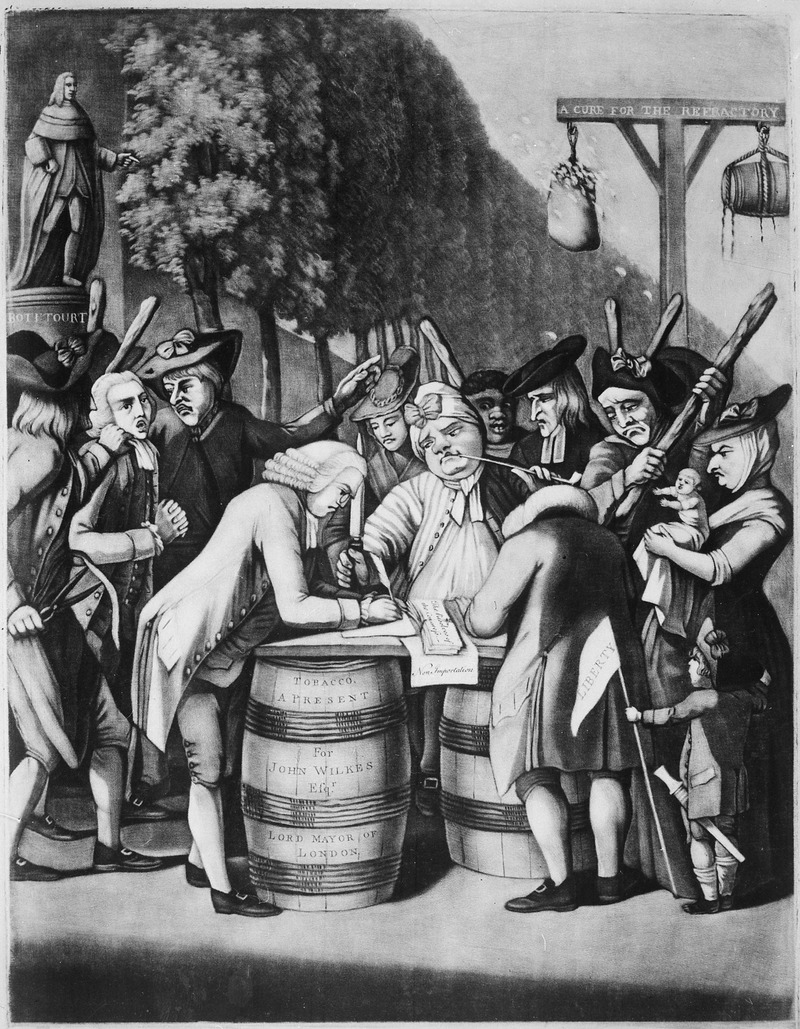
During the Stamp Act Crisis, one of the most effective methods to pressure the government into repealing the unpopular law was the boycott of imported British goods. Unfortunately for Jackson, he consistently defied the American non-importation efforts. 

When the English government passed the Townshend Acts in 1767, Jackson once again ignored the non importation agreements his fellow merchants were actively promoting.


His actions quickly drew the the attention of the Sons of Liberty, who urged Bostonians to boycott his shop. 

In 1770, anonymous broadsides declared “WILLIAM JACKSON, an IMPORTER; at the BRAZEN HEAD,North Side of the TOWN-HOUSE,and Opposite the Town-Pump, [in] Corn-hill, BOSTON It is desired that the SONS and DAUGHTERS of LIBERTY, would not buy any one thing of him, for in so doing they will bring disgrace upon themselves, and their Posterity, for ever and ever, AMEN.” 

The same year, a newspaper advertisement listed Jackson as among “the Names of those who audaciously continue to counteract the united Sentiments of the Body of Merchants throughout NORTH AMERICA, by importing British goods contrary to the agreement.”

At the outbreak of the American Revolution, William Jackson professed his loyalty to the British crown and remained inside Boston during the siege. When the British evacuated Boston in March, 1776, he escaped on board the brig Elizabeth. While off the coast of New Hampshire, three Continental Navy vessels, including the Newburyport built USS Hancock, captured the vessel. The Elizabeth was escorted into Portsmouth, New Hampshire and sold as a prize.

Jackson recounts the events following his capture on board the Elizabeth in a July 6, 1776 letter. According to the loyalist, “Upon my landing . . . [a] Mr Wentworth Inform'd me he must Examine my Baggage as also what Money and Paper's I had, from the former he has detain'd about £35 . . . and from the latter five setts of Bills of Exchange amounting to £100-stirlg payeable to myself. Only, after he Examined my Baggage [I] had his leave to carry it with me but haveing no Acquaintance in the Town accepted his Offer of his store.”

The next day, Jackson and other Loyalists secured passes from New Hampshire authorities to travel to Boston to petition for protection and the return of their confiscated property.

After travelling twenty miles south by carriage, the party arrived in Newburyport. Upon entering the Wolfe Tavern, word quickly spread about the presence of a Loyalist party in town. An angry mob quickly gathered and descended upon the tavern. According to Jackson, “We set of for head Quarter's, but upon our reaching Newbury Port about 20 miles whare we stopt to refresh ourselves the popular Assembled and swore we should not ride and threatened to destroy the Carriadge.”

Horrified, Jackson and the other Loyalists quickly sought the protection of Newburyport’s Committee of Safety. “We sent for the Committe of safety to Appease them, but all to no purpose, finding ourselves in such a situation we comply'd, the Committe not thinking it safe they Appointed a Guard of five Men and Obliged us to pay the Expence the rest of the Journey.”


Unfortunately, the bodyguards did little to protect them. As Jackson recalled “as soon as we came out of the Inn we received Blow's, mud, stones, Eggs, and every other abuse.” The small band of refugees fled Newburyport and “proceeded to Boston being 40 miles on foot.”

Upon arrival in Boston, Jackson and the others were quickly arrested and imprisoned. The following year, jackson was tried for the crime of attempting to profit from the distress caused by the American Revolution. He was convicted and ceremonially banished from Boston. Shortly thereafter, Jackson fled to England. He was formally banished by the Massachusetts legislature in 1778.

He died in England in 1810.