Wednesday, July 17, 2019

"Far Beyond Any Honest Means" - Was a Child Arsonist Responsible for the Great Fire of 1811?

Newburyport’s Great Fire of 1811 has recently been on the nerds’ collective mind. The May 31, 1811 conflagration consumed over sixteen acres of the modern downtown area and caused over two million dollars in damage. When taking inflation into account, this roughly translates to somewhere between forty million and seventy million dollars in 2019 USD currency. By the time the fire was extinguished, Newburyport was economically and physically devastated.

Often visitors to Newburyport will ask the historical tour company Untapped History who was responsible for the fire. Admittedly, to this day no one knows who started the fire. At the time, many of the residents suspected that an arsonist set the fire in a stable or shed near Mechanic’s Row. A sizeable reward was offered for information leading to the apprehension of the culprit, but no one came forward.

Recently, we’ve come across several essays and books from modern historians who have indirectly suggested that the teenage arsonist Stephen Merril Clark may have been responsible for the fire. Similarly, we’ve encountered inferences from media sources that imply Clark was also responsible for Portsmouth’s (NH) Great Fire of 1813.

So who was Stephen Merril Clark and was he responsible for the Great Fire of 1811? 


Clark was born on August 20, 1804, and was the son of Moses Clark of Newburyport. According to one early 19th Century account, the boy quickly “betrayed a stubborn and refractory spirit, often too turbulent for control. As he advanced in years it became more and more visible that mischief was his element, and falsehood and profanity became so habitual to him that a lie, or an oath were usually on his tongue, and the most vulgar insolence and abuse to his superiors were his characteristic traits.”

Shortly after his fourteenth birthday, he was brought before a magistrate for an assault and battery that he committed against an elderly man. Other accounts document how Merrill was the prime suspect in several petty thefts as well as far “more heineous depredations, as he often showed sums of money to an amount far beyond any honest means of obtaining them, which he was known to possess.”

In an effort to dissuade future criminal behavior, Moses Clark placed his son in the service of a relative to learn the trade of a baker. Unfortunately, Steven continued to engage in criminal mischief while with the relative and “was sent away on account of his bad conduct.” Desperate to steer him away from a life of crime, Stephen’s parents then arranged for him to serve as an apprentice to a Newburyport cooper. Unfortunately, “after three weeks' gross misconduct and several thefts from his master” he ran away to parts unknown.

Eventually, he returned and for the next three years Clark “loitered about the streets without employment or restraint; and spent his time in vile company and wanton mischief, insulting all who rebuked him for his conduct with the most hardy insolence.”

His father became so distraught over Stephen’s demise that in early August 1820, he begged the Newburyport selectmen to place his son in protective custody. Unfortunately, town leaders declined to interfere. Desperate to remove his son from a life of crime, Moses Clark appeared before a magistrate and swore out a warrant accusing his son of assault. However, when Stephen made a “show of penitence and promise of amendment, he (Moses) directed the officer not to serve the warrant at that time; and it was reserved in terrorem.”

Stephen Merrill Clark was never arrested and three days later, the teen tried to burn Newburyport to the ground.


According to period accounts, Newburyport had been plagued with suspicious fires throughout the summer of 1820. During the evening of August 16th, a building was torched and completely gutted. A few hours later, during the early hours of the 17th, the inhabitants of Newburyport were awoken to the sound of battle rattles being spun, bells ringing and the fearful outcry of “fire!”. This particular blaze started in a stable and quickly spread to a nearby dwelling where an entire family was sound asleep. Miraculously, the family escaped unhurt.

The fire burned for the next several hours and destroyed no less than nine residences and commercial buildings between Charter and Temple Streets.

Clark was immediately identified as the prime suspect and was quickly arrested. However, his father came forward and swore under oath that his son was at home in bed at the time of the fire. Without sufficient evidence, the boy was released from custody. In a last-ditch effort to get his son out of Newburyport and away from a life of crime, Moses sent Steven to Belfast, Maine to secure employment.

Of course, it didn’t help matters that Steven allegedly declared before his departure “that he would soon return, and set fire to the town in several places, so as it would not be extinguished.”

Unfortunately, Clark was unsuccessful securing work in Maine and sailed to Boston. After spending a brief time in the city, he began to walk home by way of Ipswich.

Meanwhile, a Newburyport prostitute by the name of Hannah Downes came forward and testified before a magistrate that Clark was responsible for the various fires in town. According to Downes, the teen had “smuggled a note telling her that he had started the fires. She immediately informed the authorities and told them also that he had confessed his crime to her the day after.” Later, the prostitute would recount how Clark had “told me he set fire to the building … that he went to his father's cellar, got a candle, broke it and thought it would not do; then took some matches and his cigar and went to Cross' stable between 8 and 9 or 7 and 8, I can not recollect which. He went up into the upper loft of the stable … scraped up a handful of hay and put it under the stairs, put the candle in the hay, lit his match with his cigar and lit the candle and went down from the stable to the fence.”

A warrant for Clark’s arrest was sworn out and the boy was apprehended while he was still in Ipswich.

Clark was tried for the capital offense of Arson in Salem in October 1821. During the proceedings, the prosecution revealed that he had not only admitted his guilt to Hannah Downes but to several other individuals who had visited him while he was held in a Newburyport jail.

However, Clark denied committing the crime and his attorney tried to establish an alibi. Unfortunately, the affirmative defense was rejected by the jury and he was found guilty. The next month the boy was executed. 


Prior to his death he confessed to starting several Newburyport fires and placed the blame for his conduct squarely at the feet of Hannah Downes, who Clark charged had persuaded him to set the fires.

Of course, all of this still begs the question: did Stephen Merrill Clark start the Great Fire of 1811?

At the time of the Great Fire of 1811, Clark would have been approximately six years old. The American Psychological Association has identified child arsonists as young as four. According to the organization, children who only set fires once or twice and then terminate the behavior are typically classified as “curiosity firesetters”. On the other hand, if a child is repeatedly setting fires throughout their childhood and teenage years as a way to secure emotional and physical relief, then they are usually classified as “pathological firesetters”. This group of firebugs will often cause significant property damage and will also engage in aggressive and confrontational behavior.

Clark was living in Newburyport at the time of the Great Fire of 1811. From the testimony at trial and the accounts of Steven Clark’s childhood, there is some evidence that supports the proposition that he was a pathological firesetter.

For example, the prosecutor at Clark’s trial subtly suggested that perhaps the teen was a firebug who was responsible for the various fires that had plagued the town over the previous decade. During the rebuttal phase of the trial, he also introduced testimony from three witnesses who asserted Clark was a serial arsonist. A blacksmith who had repaired the boy’s shackles while he was in custody awaiting trial asserted Clark had threatened to burn the man’s house and all of Newburyport to the ground if he ever escaped. Ephraim Sweet testified that Clark had previously tried to burn down his shop while a gentleman identified only as S.W. Marston declared that the boy’s father often complained that as a result of his son’s behavior, he “could not sleep nights, for he was afraid he should wake up and find the town on fire.”

Following his conviction, the teen gave a full confession and described the other fires he set prior to the August fire. For example, he described how he and another boy had tried to set fire to a rum distillery located on Brown’s Wharf. When he was asked why he did this, he stated he had no ill will towards the owner of the distillery or the wharf and had “no cause for harbouring the design, which he had meant to execute.”

Of course, one could also argue that Clark was not involved with the 1811 fire. On the eve of his death, Clark was asked when he started setting intentional fires in Newburyport. The teen stated he only started committing arson after he had fallen in love with Hannah Downes and acted solely at her direction. Furthermore, in his post-conviction confession, he never mentions the 1811 fire.

So, was Steven Merrill responsible for the Great Fire of 1811?

We may never know!


Wednesday, July 3, 2019

"A List of Imaginary Grievances" - A Loyalist's Response to the Declaration of Independence

Boston-born Loyalist Thomas Hutchinson held several prominent positions within the Colony of Massachusetts Bay, including chief justice, lieutenant governor, acting governor, and finally governor. 

During his time in Boston, Hutchinson and his family were often the victims of mob violence. On August 15 1765 an unruly crowd descended upon his house after a rumor surfaced that he supported the Stamp Act. When Hutchinson refused to accede to the demand that he come out and explain his position, the mob broke several windows and then dispersed.

Two weeks later, on August 28, 1765, an even larger mob returned to the loyalist’s residence. Fortunately, Hutchinson managed to evacuate his family to safety. Then, as he later described it, “the hellish crew fell upon my house with the rage of divels and in a moment with axes split down the door and entered. My son heard them cry ‘damn him he is upstairs we’ll have him.’ Some ran immediately as high as the top of the house, others filled the rooms below and cellars and others remained without the house to be employed there. I was obliged to retire thro yards and gardens to a house more remote where I remained until 4 o’clock by which time one of the best finished houses in the Province had nothing remaining but the bare walls and floors.”

After General Thomas Gage assumed political and military command of the colony in 1774, Hutchinson returned to England.

Almost two years after his departure from Massachusetts, Americans drafted the Declaration of Independence.  Hutchinson publicly dismissed the document as a “list of imaginary grievances.” He quickly drafted a rebuttal, submitted it to royal authorities and had it published anonymously in English newspapers.


Initially, the former governor noted that “Their designs of Independence began soon after the reduction of Canada, relying upon the future cession of it by treaty. They could have no other pretense to a claim of independence, and they made no other at first, than what they called the natural rights of mankind to choose their own forms of Government and change them when they please.”

With the memories of the Boston mob attacks against him likely still fresh in his mind, Hutchinson was quick to point out that it was Massachusetts Bay Colony that was the driving force behind the move towards independence. “We shall find … that Massachusetts Bay is more concerned in this Declaration than any other Colony … Your Lordship must remember the riotous,violent opposition to Government in the Town of Boston, which alarmed the whole Kingdom in the year 1768. Four Regiments of the King’s forces were ordered to that Town to be aiding to the Civil Magistrate in restoring and preserving peace and order. The House of Representatives, which was then sitting in the Town, remonstrated to the Governor against posting Troops there as being an invasion of their rights . . . How ridiculous then do those men make themselves, who offer it to the world as a ground to justify rebellion?”

In regard to the American claim that England had cut the colonies off from trade via the “Intolerable Acts”, Hutchinson replied “this could not be a cause of Revolt. The Colonies had revolted from the Supreme Authority to which by their constitutions they were subject before the Act passed. A Congress had assumed an authority over the whole, and had rebelliously prohibited all commerce with the rest of the Empire. This act, therefore, will be considered by the candid world as a proof of the reluctance in government against what is dernier resort in every state, and as a milder measure to bring the Colonies to a re-union with the rest of the Empire.”

Similarly, in response to the Declaration’s criticism of imposing taxes without American consent, Hutchinson noted “How often has your Lordship heard it said that the Americans are willing to submit to the authority of Parliament in all cases except that of taxes? Here we have a declaration made to the world of the causes which have impelled separation. . . And I know, my Lord, that these men, in the early days of their opposition to Parliament, have acknowledged that they pitched upon this subject of taxes because it was most alarming to the people, every man perceiving immediately that he is personally affected by it.”


In arguing for separation, the subscribers to the Declaration asserted that His Majesty’s government had committed a wide array of atrocities, including waging war against loyal subjects, kidnapping sailors on the high seas, burning towns and “[destroying] the lives of our people.” These specific claims troubled Hutchinson and led him to assert that the rebelling colonies were solely responsible for their own misery. “These, my Lord, would be weighty charges from a loyal and dutiful people against an unprovoked Sovereign. They are more than the people of England pretended to bring against King James the Second in order to justify the Revolution. Never was there an instance of more consummate effrontery. The Acts of a justly incensed Sovereign for suppressing a most unnatural, unprovoked Rebellion are here assigned as the causes of this Rebellion. It is immaterial whether they are true or false. They are all short of the penalty of the laws which had been violated. Before the date of any one of them, the Colonists had as effectually renounced their allegiance by their deeds as they have since done by their words. They had displaced the civil and military officers appointed by the King’s authority and set up others in their stead. They had new modeled their civil governments and appointed a general government, independent of the King, over the whole. They had taken up arms, and made a public declaration of their resolution to defend themselves against the forces employed to support his legal authority over them.”

In the conclusion of the rebuttal, the former Massachusetts leader stressed that the Declaration was nothing more than a feeble attempt to justify rebellion and there were many men who supported the crown but feared to speak out due to the violent tendencies of American mobs. “They have, my Lord, in their late address to the people of Great Britain, fully avowed these principles of Independence by declaring they will pay no obedience to the laws of the Supreme Legislature … and have endeavored to persuade such as they called their British Brethren to justify the Rebellion begun in America, and from thence they expected a general convulsion in the Kingdom . . .The people have not observed the fallacy in reasoning from the whole to part, nor the absurdity of making the governed to be governors. From a disposition to receive willingly complaints against Rulers, facts misrepresented have passed without examining. Discerning men have concealed their sentiments, because under the present free government in America, no man may, by writing or speaking, contradict any part of this Declaration without being deemed an enemy to his country, and exposed to the rage and fury of the populace.”

Tuesday, June 25, 2019

"The Armed Schooner Success" - How a Newburyport Privateer Caused a Diplomatic Dispute with Spain

The Privateer Success was a schooner that was owned by the wealthy Newburyport merchant Nathaniel Tracy. In May of 1776, Tracy decided to convert the vessel into a warship and outfitted it with two cannons and eight swivel guns. The ship was commanded by John Fletcher and had a crew complement of two lieutenants and fourteen men. After securing a letter of marque and paying a $5000 bond, the vessel left Newburyport in search of British supply vessels.

Captain Fletcher’s first cruise was uneventful and ended in the Spanish port of Bilbao. While there, the Success rendezvoused with the Massachusetts Privateer Hawke, which was under the command of Captain John Lee. The two captains agree to sail together on a return cruise and left Bilbao on October 23, 1776. Unfortunately for both privateers, several English supply vessels received intelligence on the privateers whereabouts and altered their respective courses to avoid the rebel ships.

However, on January 20, 1777, while off the New England coast, the two vessels encountered the British 100-ton brigantine Betty. After a brief chase, the vessel was captured and escorted into Newburyport as a prize.

Shortly thereafter, the Succes made a second voyage to European waters. By June 16, 1777 she was once again in Bilbao. The following month, she was patrolling off the coast of Ushant, France with the Massachusetts Privateer General Mifflin.

On September 18, 1777 the 120-ton brigantine Isabel was captured by the two privateers. A week later the Success captured the Endeavour as it was travelling from London to Villavisiosa, Spain. Three days later, on September 28th, the privateer captured two more vessels, the William and Polly and a French vessel sailing from the Isle of Jersey to La Rochelle, France.


On September 2, 1778, the Success was back in Newburyport for refit and repairs. A period account suggests that the Success upgraded its armaments and now had “eight guns and ten swivel guns mounted”. Likewise, the privateer’s crew size more than doubled from sixteen men and officers to forty-three.

While in port, command of the ship was turned over to Captain Phillip Trask of Beverly, Massachusetts.

Captain Trask departed from Newburyport on October 4, 1778. (Interestingly, prior to the Success’ departure, Nathaniel Tracy took out not one but two bonds for her ship: a $5000 Continental bond and a “£4000 Massachusetts” bond.) At first, the privateer’s cruise was uneventful and was marked by humorous events such as the sighting of “a damn d Comical Boat by G..d”. 

However, two months later, the activities of the Success nearly triggered an international incident between the soon to be American ally Spain and the United States.

On December 30, 1778, the Newburyport privateer encountered the brigantine Santander y los Santos Martires. The Spanish vessel was en route from London to Cadiz and was loaded with commercial goods. 

When it was sighted by the Success, it was flying a Spanish flag. Nevertheless, the Newburyport privateer bore down on the brigantine and intercepted it. The Americans then boarded the vessel, examined the cargo manifests and declared the ship and all the goods on board were to be seized because they were British in origin.

Horrified, the Spanish captain assured Trask that the cargo was Spanish owned and provided invoices in support of his position. He also provided proof that the vessel was owned by the Spanish merchant Don Philip Aguixxe de San Fadder. Surprisingly, Captain Trask ignored the Captain’s pleas and declared the Santander y los Santos Martires a captured prize. The vessel was escorted back to Boston where it was formally forfeited in April 1779. 


The Spanish shipowner appealed the decision to the Massachusetts courts.

Understandably, the Spanish government was outraged at the incident and submitted a formal protest through Don Juan Miralles, the unofficial Spanish representative to Congress. It also submitted a protest through their French allies. On April 24, 1779, the French diplomat to the United States, Conrad Alexander Gerard, submitted a second objection to the seizure of the Santander y los Santos Martires.

Congress was confronted with a diplomatic dilemma. On the one hand, Massachusetts representatives argued that the owner, officers, and crew of the Success were entitled to keep the proceeds of its prize. On the other hand, Spain demanded that the vessel and its cargo be returned to its rightful owner. 


After several competing memorials from Don Philip Aguixxe de San Fadde, Nathaniel Tracy, Captain Trask and several other individuals were submitted, Congress ordered a special committee be formed to determine how it should best respond. Ultimately, the committee recommended that the Massachusetts appellate courts should decide the fate of the Santander y los Santos Martires. It also recommended that Congress should assure Spanish officials that it would reimburse the aggrieved party if he did not prevail on appeal. Congress quickly agreed to the recommendation.

In October 1779, the Massachusetts appellate court ruled “that the brigantine Santander y los Santos Martires [Holy Martyrs] was Spanish property but that her cargo was British. The court therefore awarded the cargo to Nathaniel Tracy and John C. Jones, merchants and owners of the armed schooner Success, commanded by Philip Trask, which had captured the Holy Martyrs on December 30, 1778”.

Following the ruling, Congress once again intervened in the matter. On November 9, 1779, the American government declared “that the said Brigantine or Vessel called the Holy Martyrs, her tackle, Apparel and Furniture and all and singular the Goods, Wares and Merchandizes laden and found on board her at the Time of her Capture as mentioned in the said Bill be forthwith restored and redelivered and the said Joseph De Lano the Claimant in the said Cause his Agent or Attorney to and for the Use of himself and all others on whose Behalf he claims and appeals.”

Congress then issued a resolution ordering Nathaniel Tracy pay for the legal costs incurred by 
Don Philip Aguixxe de San Fadde. “And We do further order and decree that the party Appellant pay unto the party Appellee one thousand and fifty six Dollars for his Costs and Charges by him expended in defending the said Appeal in this Court &c.”

Not surprisingly, Tracy refused to pay the costs and petitioned the Massachusetts congressional delegation for assistance. After extensive negotiations, Congress eventually backed down and formally recognized the ruling of the Massachusetts courts regarding the seizure of the Santander y los Santos Martires.

Whether Don Philip Aguixxe de San Fadde was ever reimbursed by Congress for his loss remains unknown.


The Success continued to engage in privateer operations until 1780 when it was retired from service.

Friday, June 21, 2019

"Scabbards and Tann’d Leather Slings" - Did Massachusetts Militiamen Use Musket Slings on April 19th?

Every now and then, the nerds will go down the rabbit hole of obscurity to discuss miniscule details of the arms and equipment of Massachusetts militia and minute companies on the eve of the Battles of Lexington and Concord. This is one of those occasions.
About six months ago, we received an inquiry as to whether or not Massachusetts militiamen utilized musket slings on April 19, 1775. Admittedly we put aside the question for far too long and are finally getting off our collective butts to address this issue now.

The short answer is musket slings were likely not in widespread use on the eve of Lexington and Concord. A careful examination of pre-Revolutionary War Massachusetts militia laws, Provincial Congress and town resolutions, invoices, and lost property claims reveal that the use of musket slings by Massachusetts militia and minutemen was almost unheard at the outset of the war.

First, a review of late 17th and 18th century Massachusetts militia laws for the term “sling” or “slings” surprisingly comes up with no results. For example, a late 17th century militia law stated “Every listed souldier ... shall be alwayes provided with a well fixt firelock musket, of musket or bastard musket bore, the barrel not less then three foot and a half long, or other good firearms to the satisfaction of the commission officers of the company, a snapsack, a coller with twelve bandeleers or cartouch-box, one pound of good powder, twenty bullets fit for his gun, and twelve flints, a good sword or cutlace, a worm and priming wire fit for his gun.” Similarly, a 1733 militia law that appeared in the Boston Newsletter makes no reference to musket slings. “Every listed Soldier, and other Householder shall be always provided with a well fixt Firelock Musket, of Musket or Bastard-Musket bore, the Barrel not less than three Foot and an half long, or other good Fire Arms to the satisfaction of the Commission Officers of the Company; a Cartouch Box: one Pound of good Powder: Twenty Bullets fit for his Gun, and twelve Flynts; a good Sword or Cutlass; a Worm, & priming Wire, fit for his Gun, on Penalty of six Shillings.” 


Likewise, when the Massachusetts Provincial Congress issued a list of recommended arms and equipment for its minute companies, musket slings were conspicuously absent. Similarly, there is not a single reference to musket slings in any of the forty Massachusetts town resolutions the nerds reviewed. For example, On November 21, 1774, the Town of Danvers resolved its minute companies would be equipped with “an effective fire-arm, bayonet, pouch, knapsack, thirty rounds of cartridges and balls”, but no musket slings. In Bradford, the town voted to only supply its men with “bayonets and cartouch boxes for the Minute-Men on the town cost” but never ordered the procurement of slings. On October 24, 1774, the Town of Newburyport resolved to equip its militia companies “with arms and ammunition according to Law, and that they have, also, Bayonets fixed to their Guns as soon as may be.” Consistent with other Massachusetts communities, the resolution made no reference to militiamen being supplied with slings for guns. Finally, in Brimfield, the town declared it would “provide for 50 minute men a Cartridge Box, Knapsack, and thirty rounds of cartridge and ball a sett for each private in said Company to be provided imemdiately.” Again, there is no reference of musket slings.

Many, if not most, Massachusetts towns were making or providing arms and equipment to those residents who either could not afford or did not own such items. Each town subcontracted the work to skilled residents within their respective communities. For example, John Parker of Lexington was making powder horns, Phineas Carlton of Bradford was repairing bayonets and Israel Litchfield of Scituate was making cartridge boxes. In almost every instance, the makers submitted bills to their respective towns for services provided. A review of those invoices suggests that musket slings were not high priority. In Bradford, residents were compensated for repairing bayonets and carriages to carry them, but not for slings. “Voted, To Phineas Carlton, for 22 Bayonets fitted with Scabbards and Belts, 8l. 5s. 0d. Voted, To Phineas Carlton, for Scowering the old Bayonets, and fitting with Belts, 4l. 4s. 0d. For 2 Scabbards and Belts, 0l. 3s. 0d. Wm. Greenough, for fitting one Bayonet and one belt, 0l. 2s. 8d.” In Springfield, several individuals were compensated for making cartridge boxes and knapsacks, repairing bayonets and securing muskets. However, there is no reference to musket slings being made or repaired.


Similar requests for compensation in Haverhill, Ipswich, Methuen, Chelmsford and Lexington also lack references to slings.

Following the Battles of Lexington and Concord, many militiamen submitted financial claims for lost or stolen property to either the Massachusetts Provincial Congress or the Massachusetts Legislature. Similar claims were also submitted following the Battle of Bunker Hill on June 17, 1775. Once again, references to musket slings were noticeably absent. For example, several families from Lexington submitted claims for property stolen from the dead or wounded during the Battle of Lexington. According to one such claim, “Petition of Benja Wellington, & others of Lexington, setting forth that they sustained the aforementioned losses by the Kings troops on the 19th of April 1775 viz: Benja Wellington, a gun, bayonet, &c. … Jno Muzzy, a gun, powder horn, &c. Taken from his son … Lucy Parker, a musquet, &c. Taken from her husband … Marrit Munro, a gun & hat taken from him.” 

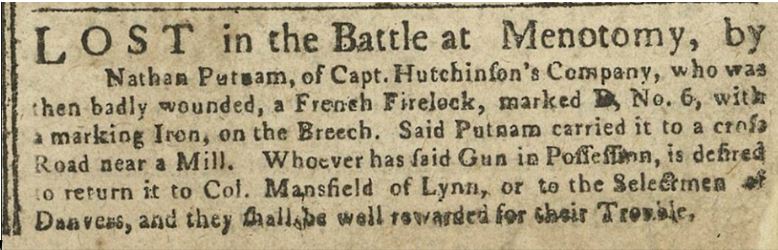
Nathan Putnam took out a newspaper advertisement describing his “French Firelock”. Although he describes certain markings on the gun, he makes no reference to a sling. Finally, claims for property lost at Bunker Hill included the terms “gun”, “knapsack”, “hat”, “Jaccat”, “tumpline”, “stockens”, “breeches” and “hankerchief”. Unfortunately, we could not locate any reference to slings.


We do want to stress that this does not mean that musket slings were simply non-existent within the ranks of Massachusetts forces in 1775. There is evidence that musket slings were issued to Massachusetts provincial troops in the spring of 1756. The shipment sent to the colony included “Land service muskets of the King’s pattern with brass furniture, double bridle locks, wood rammers with bayonets & scabbards and tann’d leather slings.” It is possible some of these issued slings survived to see service on April 19th.

Of course, more research needs to be conducted on this issue. If you happen to have any additional information or insight, we’d love to hear from you!


Wednesday, May 29, 2019

It's Not Easy Being William Jenkins

The nerds would like to apologize for being among the missing the past several weeks. We were hit with a very nasty illness and we needed some time to recover. Rest assured, we’re feeling much better and what better way to kick off a return than a discussion about 18th-century smuggling!

In previous postings, we’ve alluded to how Newburyport on the eve of the American Revolution was a hotbed for smuggling activities.

Traditionally, the seaside community has always been an ideal location for smugglers to operate from The Merrimack River, as well as the Plum Island and Salisbury coastlines, provided ideal havens for criminals to unload their goods underneath the nose of royal custom officers stationed in the town. Of course, the illicit operations were so successful that by 1766 it caught the attention of Governor Francis Bernard. The leader of Massachusetts Bay Colony was horrified by the reports coming out of Newburyport and ordered Surveyor General John Temple to crack down on the illegal activity. After careful consideration, he turned operational oversight of the crackdown over to William Jenkins.

Jenkins was a “tidewaiter” assigned to the royal custom office in Newburyport. As a tidewaiter, he was responsible for boarding ships that arrived in port and ensuring custom regulations and procedures were strictly followed during cargo inspections. The custom officer readily accepted his assignment and went to work gathering intelligence from the few willing informants he had. He quickly discovered Newburyport smugglers were bringing in illegal goods from two separate locations: the French colonies in the West Indies and St. Petersburg, Russia.

The tidewaiter wasted no time and moved against a Newburyport schooner that was smuggling goods to and from Saint Petersburg. “I have learned from private intelligence that the Schooner which brought in these goods is a common trader to St. Petersburg … She was seized upon an information that She had tobacco on board.” 

Surprisingly, Jenkins did not keep a close watch on the vessel and left it unguarded. A group of Newburyport men quickly boarded the vessel and removed the tobacco before custom officers could seize it. Without any evidence, Jenkins was forced to release the vessel.


The customs officer did not give up and made a second attempt to seize the same ship. On March 9, 1766, the vessel returned from a subsequent voyage to Russia, Jenkins moved singlehandedly to seize the schooner and its cargo. In response, a large group of Newburyport dockworkers and laborers rushed the custom officer, overpowered him, boarded the ship and carried off the illicit goods. As Jenkin’s superior later noted, “After She was discharged She went immediately to St. Peters & returned with a cargo ... Upon this occasion People do not wonder at the goods being rescued, but at an Officer’s being so hardy & foolish (as they say) as to seize them & think he would be able to retain them. Under the present Dominion of the people I have never expected that Any goods, tho’ ever so notoriously forfeited, would be seized, or secured, or prosecuted.”

To his credit, the events of March 9th did not deter Jenkins from trying to stop local smuggling operations. The next day, the customs officer watched as the same schooner engaged in unusual activity between Rings Island and the mouth of the Merrimack River. According to official reports, Jenkins believed there had been “goods landed from said schooner contrary to Acts of Trade.” He gathered several of his men, boarded a batteaux and went to investigate.

Late in the afternoon, Jenkins and his men stumbled across four barrels of sugar and twelve hogsheads and four tierces of molasses hidden on a narrow strip of beach located on the Salisbury side of the mouth of the Merrimack River. He quickly declared the items to be smuggled goods and ordered his men to load them onto the batteaux. 

Little did Jenkins know that he was being watched the entire time by the owners of the seized property.

As the custom officials were loading the batteaux, six boatloads of “armed Men in Disguise” arrived to rescue the goods. They quickly drove Jenkins and his men back, seized the barrels and hogshead and quickly escaped. To add insult to injury, the raiders stole the custom officers’ boat, leaving them stranded on the beachhead. As the sun set, it started to snow heavily. Stranded and facing no hope of rescue until the next morning, Jenkins and his men were forced to huddle together for warmth, “sheltering from a snowstorm as best they could.”

Governor Bernard was quickly informed of the incident by John Temple. Enraged, the governor and his council issued a proclamation seeking the apprehension of Jenkins’s attackers and the recovery the smuggled goods. Bernard even offered a handsome reward of £50 for any information about “these riotous and unlawful proceedings” and a pardon to anyone who might turn king’s evidence. No one in Newburyport came forward.


On March 17, 1766, John Temple upped the ante and added “a reward of 100 dollars” for any information leading to the arrest of Jenkins’ assailants. Although “private intelligence” provided to Jenkins by an informer revealed the comings and goings of a Newburyport vessel trading illegally with the French island of St. Pierre in the Gulf of St. Lawrence, the residents of Newburyport remained tight-lipped about who was behind the March 10th attack on the customs officers.

Monday, April 8, 2019

“Ye Villains! Ye Rebels! Disperse, Damn You! Disperse!” - Four More Myths About the Battle of Lexington

Last week the nerds shared four common misconceptions surrounding the Battle of Lexington and its participants. As we lead up to the annual celebration of Patriot’s Day, here are four more common misbeliefs about the April 19, 1775 engagement.

Captain Parker’s Company was not properly armed and equipped
A common misconception about the Battle of Lexington is that Captain John Parker’s Company was sparsely armed and equipped. Starting in the early 19th Century and well into the 20th Century, paintings, images, historical interpretations and fictional accounts of the Battle of Lexington have depicted the town’s militia company as carrying little to no equipment.

However, a review of period documentation, including primary accounts of the Battle of Lexington, town records and probate inventories show that the Lexington Company actually assembled on the common fully equipped for a military campaign. 

Image by Stephanie Godley

On December 10, 1774, the Provincial Congress declared “The improvement of the militia in general in the art military has been therefore thought necessary, and strongly recommended by this Congress. We now think that particular care should be taken by the towns and districts in this colony, that each of the minute men, not already provided therewith, should be immediately equipped with an effective firearm, bayonet, pouch, knapsack, thirty rounds of cartridges and balls . . . [that], as the security of the lives, liberties and properties of the inhabitants of this province, depends under Providence, on their knowledge and skill in the art of military, and in their being properly and effectually armed and equipped, it is therefore recommended, that they immediately provide themselves therewith; that they use their utmost diligence to perfect themselves in military skill”. When the Massachusetts Provincial Congress issued a resolution regarding the arms and equipment to be carried by its minute and militia companies, Lexington quickly responded. Two days after the Provincial Congress order, the Lexington selectmen ordered the militia to appear at the meeting house for an inspection. During the review, deficiencies in arms and equipment were apparently observed. As a result, the selectmen quickly scheduled a town meeting. On December 27, 1774, the residents reviewed their options and voted to form a committee that would oversee measures to ensure the militia was prepared for war. “Votede . . . That seven persons be appointed as a committee of inspections to see that the plans of the . . .Provincial Congresses are faithfully carriede into executione.”

One of the individuals assigned to the committee was Captain John Parker, commander of the Lexington militia. Over the next several months it appears that this committee took steps to ensure the company was properly armed and equipped. As a result of this effort, several men in Lexington personally contributed to Lexington’s effort to properly arm and equip the town’s militia for war. Jonathan Harrington Sr., the father of company fifer Jonathan Harrington, and Phillip Russell were charged with making cartridge boxes and belting for the militia. Jeremiah Harrington was making tow cloth knapsacks while John Parker was possibly making powder horns for the Lexington Company. Jonas Parker was cutting back gunstocks so fowlers could accept socket bayonets and Nathan Simonds was providing blankets to those Lexington militiamen who could not afford them.

So, did Parker’s Company carry cartridge boxes, muskets, bayonets, powder horns, blankets and packs when it assembled the morning of April 19, 1775? There are several pieces of evidence which support the proposition that it did. 

First, in the aftermath of the Battle of Lexington, thirty-three Lexington militiamen signed a deposition asserting they were “alarmed” and appeared at the company parade. The legal term “alarmed” was a 17th and 18th-century legal term describing a militia’s response to an emergency situation. Under Massachusetts colonial militia laws between 1690 and 1773, when a company was alarmed, they were also required to rally armed and equipped for a military campaign. Second, according to the 1776 anniversary sermon of the Reverend Jonas Clarke, there was a debate over whether the company should dismiss and reform at another location. Clarke also discussed how Parker’s Company was prepared to respond to any military emergency, regardless of the location. “Upon this intelligence, as also upon information of the conduct of the officers as above-mentioned, the militia of ths town were alarmed, and ordered to meet on the usual place of parade; not with any design of commencing hostilities upon the king’s troops but to consult what might be done for our own and the people’s safety; And also to be ready for whatever service providence might call us out to, upon this alarming occasion in case overt acts of violence or open hostilities be committed by this mercenary hand of armed and blood thirsty oppressors.”

There is also the official correspondence from Lt. Colonel Francis Smith. In his report to General Thomas Gage regarding the events of April 19th, the expedition commander specifically states the Lexington militia was drawn up in military order, armed and fully equipped. “I think it proper to observe, that when I had got some miles on the march from Boston, I detached six light infantry companies to march with all expedition to seize the two bridges on different roads beyond Concord. On these companies' arrival at Lexington, I understand, from the report of Major Pitcairn, who was with them, and from many officers, that they found on a green close to the road a body of the country people drawn up in military order, with arms and accouterment, and, as appeared after, loaded.”

Finally, there the petitions from several Lexington men or families who described how British troops looted the dead and wounded of their arms and equipment in the aftermath of the skirmish. John Tidd submitted a petition to the Massachusetts Legislature in early 1776 claiming that after he was wounded at the Battle of Lexington, British soldiers robbed him of his arms and equipment. “Petition of John Tidd of Lexington setting forth that on the 19th of April he received a wound in the head (by a Cutlass) from the enemy, which brought him (senceless) to the ground at wch time they took from him his gun, cartridge box, powder horn &c.” Likewise, Benjamin Wellington and two other individuals submitted claims that stated “Petition of Benja Wellington, & others of Lexington, setting forth that they sustained the aforementioned losses by the Kings troops on the 19th of April 1775 viz: Benja Wellington, a gun, bayonet, &c. … Jno Muzzy, a gun, powder horn, &c. Taken from his son … Lucy Parker, a musquet, &c. Taken from her husband … Marrit Munro, a gun & hat taken from him.”

There were very few spectators present at the Battle of Lexington.

One important aspect of the Battle of Lexington that has been often overlooked by historians is the psychological and physical impact upon the civilian populace. David Hackett Fisher argues in his work, Paul Revere’s Ride, that a large number of spectators from Lexington and nearby towns gathered along the edge of the town common to watch how the events would unfold. Unfortunately, Fisher’s assumption is most likely incorrect.

When Lexington’s alarm bell began to toll in the early morning, most residents recognized that a hostile military force was marching directly towards them. With the possibility of the town being subjected to plunder and destruction, a panic set in. Many who lived along the Boston Road prepared to evacuate. Anna Munroe, wife of Sergeant Munroe, started to bake bread for her husband. Later she confessed, “I mixed my bread last night with tears coming, for I feared I should have no husband when the next mixing came.” The Reverend William Gordon of Roxbury noted “the inhabitants had quitted their houses in the general area upon the road, leaving almost everything behind them, and thinking themselves well off in escaping with their lives.” Some escaped with a few select belongings. Others quickly hid or buried valuables before leaving. One 19th century Lexington account suggested many residents “hid their silver and mirrors and many other things in [a] swamp. The Reverend Clarke's family hid “money, watches, and anything down in the potatoes.” Captain Parker’s wife, Lydia, “took all the valuables and hid them in a hollow trunk of a tree standing some distance from the house.” Lydia Mulliken and her daughters, who lived along the Boston road, heard the alarm and hurriedly buried the family’s silver and other valuables by a stone wall near their clock shop, then fled to distant safety. Mary Sanderson gathered her children and “taking such articles as they could hurriedly collect and carry in their arms, by the light of a lantern [made their way] to a refuge, the home of her father in New Scotland.” The Loring daughters scurried to hide the communion silver in a brush heap back of the house before fleeing.

Ralph Earl, The Battle of Lexington, April 19th, 1775, etched by Amos Doolittle

For some women, the flight was particularly difficult. Four women, Sarah Marrett, Amity Pierce, Sarah Reed and Betty White, were still likely bedridden having given birth over the past month. Sarah Reed and her newborn child had to be carried out her home on a mattress by her husband and in-laws. Three others, Dorcus Parker, Elizabeth Estabrook and Lydia Harrington, were all over eight months pregnant. Other women rushed to get their young children to safety. Abigail Harrington, took her toddlers “down a lane back of the house across a meadow to the old place on Smock farm.” Anna Munroe fled from the family tavern with her three young children and hid on a hill behind the establishment.

Several Lexington militiamen in later accounts recounted how they passed the time waiting for the regulars by taking shelter in vacated homes along the Green.

Thus, most of Lexington's women and children who resided along the Bay Road were likely long gone and out of the way by the time Major Pitcairn arrived in Lexington.

However, this is not to say there were no spectators. Instead, period accounts suggest there was a small smattering of spectators who witnessed the battle. Local tradition suggests that the wife of Jonathan Harrington, who was killed in the engagement, was too ill to evacuate and observed the battle from the second floor of her home. Thomas Rice Willard watched the battle from a window in Daniel Harrington’s house, also located at the back of the Lexington common. William Draper, a resident of Colrain, Massachusetts who happened to be in Lexington on April 19th watched the battle from an unknown location. Finally, Thomas Fessenden asserted that as he stood in a pasture, he watched the regulars enter the common and rush the training band “at about half an hour before sunrise.”

There were Loyalists present at the Battle of Lexington.

Wait … what?

When Smith’s expedition departed from Boston, present with the column were the Loyalist guides who either volunteered or were recruited to assist the mission to Concord. Little has been written about the role Loyalists played in Gage’s military operation. A review of primary sources, including Loyalist claims for compensation after the American Revolution, suggests that at least six loyalists were recruited to assist Lieutenant Colonel Smith’s expedition by navigating colonial roads and assisting troops in locating military stores in Concord.

Among the guides were former Harvard classmates and friends Daniel Bliss of Concord and Daniel Leonard of Taunton. Both were well established attorneys who were forced to flee to the safety of Boston in 1774. It was suspected by many Massachusetts Loyalists that Leonard was the anonymous author “Massachusettensis”, who had published a series of pro-government letters drafted in response to the political arguments of John Adams.

Dr. Thomas Boulton of Salem and Edward Winslow Jr. of Plymouth also volunteered for the mission. Boulton was a vocal supporter of Crown policies towards Massachusetts and was forced to flee to Boston in 1774. Winslow held several political and legal posts in Plymouth County. Sensing a radical shift in the political mood in October of 1774, he abandoned his estate and also retreated to Boston.

Another Loyalist was William Warden. Warden was born in Boston and was a shopkeeper, grocer and barber. Unlike many of his station, Warden had been opposed to the political and violent activities of the Massachusetts “patriots” since the Stamp Act. 

Image Courtesy of McAlpin's Corps of American Volunteers

It appears the guides were interspersed throughout the column. Lieutenant William Sutherland of the 38th Regiment of Foot references on two separate occasions a “guide” attached to the front of the column. “When I heard Lieut. Adair of the Marines who was a little before me in front call out, here are two fellows galloping express to Alarm the Country, on which I immediately ran up to them, seized one of them and our guide the other, dismounted them and by Major Pitcairn's direction gave them in charge to the men.” In a separate letter, Sutherland describes how a Loyalist guide identified a captured American prisoner as being a person of importance. “I mett coming out of a cross road another fellow galloping, however, hearing him some time before I placed myself so that I got hold of the bridle of his horse and dismounted him, our guide seemed to think that he was a very material fellow and said something as if he had been a Member of the Provincial Congress.”

When the British light infantry stepped onto the Lexington Green the morning of April 19, 1775, at least one to two loyalist guides were with them. In his petition for compensation to the British Government at the end of the Revolution, loyalist Edward Winslow Jr. asserted he was with the 4th and 10th Regiments of Foot when they advanced on Captain Parker’s Company. Another loyalist suspected of being at the head of the column was Concord attorney Daniel Bliss.


The British Troops and Captain Parker’s Company were not in a standoff.

Most modern depictions of the engagement, including the movie April Morning, depict a brief but tense standoff between both sides before a mysterious shot is fired and the skirmish begins. However, in reality, the entire skirmish was over in less than five minutes.

As the British column closed in on Lexington’s common, a British sergeant reported that a party of colonial horsemen rode out from the village and shouted, “[you] had better turn back, for you shall not enter the town!” One of the mounted men then “presented a musquet and attempted to shoot them, but the piece flashed in the pan.” According to Lieutenant Sutherland, another individual fired at him from the vicinity of Buckman’s Tavern. He reported this to Pitcairn who then galloped to the front of the column, halted the men and ordered them to load their muskets and fix bayonets. “On this, I gave directions to the troops to move forward, but on no account to Fire, or even attempt it without Orders.”

William Sutherland noted “shots fired to the right and left of us, but as we heard no whissing of balls, I [concluded] they were to Alarm the body that was there of our approach.” Off in the distance, militiamen could be seen hurrying into line. “The road before you go into Lexington is level for about 1000 yards . . . when we came up to the main body which appeared to me to Exceed 400 in and about the village who were drawn up in a plain opposite the church.”

Captain Parker’s men waited nervously for the arrival of the British regulars. As the troops approached, many began to realize the danger they were in. One was bold enough to tell Parker “There are so few of us! It is folly to stand here!” The militia captain, ignoring the outcry, turned to his company and stated “Let the troops pass by, and don't molest them, without they begin first.”

Pitcairn was confronted with a military quandary. If he chose to ignore the militia company drawn up on the village common, he would be leaving an armed opponent to his rear. If he halted, he could exacerbate an already tense situation.

The light infantry officers in the lead company of the column, the 4th Regiment of Foot, resolved Pitcairn’s dilemma by directing their men towards the Lexington militia. The next regiment, the 10th Regiment of Foot, quickly followed. The two lead companies raced towards the increasingly nervous militia. Suddenly, they deployed into a line of battle, continued their rapid advance and began to shout “Huzzah!” Pitcairn, realizing the situation was getting out of hand, “instantly called to the soldiers not to fire, but rather to surround and disarm the militiamen.” Many of the excited troops and officers may never have heard this order as they continued to shout and yell. Lieutenant Edward Gould of the 4th Foot later testified that he could not hear above the noise his men were making.

Image from Hallmark's movie April Morning

Pitcairn and other officers then rode towards Captain Parker and his men. According to Sutherland, several officers began to shout, “throw down your arms and you shall come by no harm, or words to that effect.” Private James Marr of the 4th Foot believed Pitcairn exclaimed, “Stop you rebels!” However, many of the Lexington militiamen later asserted that the officers shouted “Lay down your arms, Damn you, why don’t you lay down your arms?” Militiaman John Robbins, who was in the front rank as the regulars approached, recalled the officers chastised the militia by stating, “Throw down your arms ye Villians, ye Rebels!” Spectator Thomas Fessenden heard an officer order “Disperse you rebels, immediately.” Jonas Clarke, believed he heard an officer demand “Ye villains! Ye rebels! Disperse, damn you! Disperse!”

Recognizing the situation was becoming more and more dangerous, Parker turned to his men and issued new orders. “I immediately ordered our militia to disperse, and not to fire.” Most of the men obeyed his command and began to file off the common. Some, however, either did not hear Parker’s order or chose to ignore it. As a result, several Lexington men held their ground as the light infantry surged forward.

Suddenly, a single shot rang out and the rest is history.

Monday, April 1, 2019

"To Be in Constant Readiness for Action" - Addressing Some of the Myths Surrounding the Battle of Lexington

Yesterday, the nerds had the opportunity to observe the annual dress rehearsal of the Battle of Lexington reenactment. Thankfully, the public interpreters did a wonderful job educating the public about the facts and circumstances surrounding the opening engagement of the American Revolution.

Naturally, this inspired us to address some of the more common myths surrounding the engagement. Without further delay, here is the first batch of common misconceptions and myths we’ve encountered over the years!


The Men Who Stood on the Green Were Called "The Lexington Minute Men”

Lexington’s militia was not known in 1775 as the “Lexington Minute Men”. Available research suggests a formal minute company had yet to be established by April 1775. According to period accounts, including the correspondence from the Reverend William Gordon, the Lexington militia was only divided into two bodies formally known as the Training Band and Alarm List. On the other hand, a minute company simply did not exist in Lexington.

However, depositions from some of the Lexington militiamen in the aftermath of the Battle of Lexington informally referred to their town militia not as the Lexington Training Band, but as “Captain Parker’s Company”. On April 25, 1775, Simon Winship stated the British troops “marched on till they came within a few Rods of Captain Parkers Company.” A day earlier, John Robbins asserted “that on the Nineteenth Instant, the Company under the Command of Captain John Parker, being drawn up (sometime before sun Rise) on the Green or Common.” William Draper stated “I, William Draper, of lawful Age, and an Inhabitant of Colrain, in the County of Hampshire, and Colony of Massachusetts Bay, in New England, do testify and Declare, that, being on the Parade of said Lexington, April 19th Instant, about half an hour before sunrise, the King's Regular Troops appeared at the meeting House of Lexington. Captain Parkers Company, who were drawn up back of said meeting house on the Parade, turned from said Troops, making their escape, by dispersing; in the meantime, the Regular Troops made an huzza, and ran towards Captain Parkers Company.” 


Surprisingly, a third name, “Lexington Company”, was also utilized by the town’s militiamen. In other depositions immediately following the Battle of Lexington, no less than five Lexington men refer to their unit as “The Lexington Company”. “I, Elijah Saunderson, above named, do further testifie and declare, that I was on Lexington Common, the Morning of the Nineteenth of April, aforesaid, having been dismissed by the Officers above mentioned, and saw a Large Body of Regular Troops advancing toward Lexington Company.” According to Benjamin Tidd, “the regulars fired, first, a few guns, which we took to be pistols from some of the Regulars who were mounted on Horses, and then the said Regulars fired a Volley or two before any guns were fired by the Lexington Company.”

Thus, all three names are proper references to the militia unit that fought at the Battle of Lexington.  Unfortunately, the "Lexington Minute Men" term is not one of them.


Captain John Parker Was a Veteran of the French and Indian War

Captain John Parker was the commanding officer of the American militia at the Battle of Lexington. Family tradition credits Parker with considerable military experience prior to the Revolution. It is claimed that he was present at the capture of Louisburg, served during the French and Indian War, fought in Quebec in 1759, and was a member of Roger’s Rangers.

So, did John Parker actually have military combat experience before April 19, 1775? The answer is a resounding NO.

The first time someone claimed John Parker was a veteran of the French wars was in 1893, one hundred and eighteen years after the Battle of Lexington. That year two separate publications asserted Parker had combat experience. The first was written by his grandson, the Reverend Theodore Parker. In his work Genealogy and Biographical Notes of John Parker of Lexington and His Descendants: Showing His Earlier Ancestry in America from Dea. Thomas Parker of Reading, Mass., from 1635 to 1893, the Reverend Parker states “John Parker was at the capture of Louisburg in 1758... was at the taking of Quebec in 1759 . . . [and was] made a sergeant in this war.” A second publication by Captain Parker’s great-granddaughter Elizabeth S. Parker alleged the militia captain “had served in the French and Indian War.” 


Over the next several decades, historians were quick to promote these questionable claims. Unfortunately, there are no official records, journals or surviving artifacts to support the proposition John Parker enlisted in the war effort against the French, let alone saw combat.

One claim occasionally advanced by 20th-century historians is that Parker’s father Josiah served at the 1745 Siege of Louisbourg as an officer. In turn, he must have brought his then fifteen-year-old son John along as a servant. This assertion is nothing more than bunk. There are no records that Josiah Parker enlisted in the Louisbourg expedition. In fact, town records from the period clearly establish that Josiah Parker was in Lexington and actively serving as a selectman in 1745.

Likewise, a review of marriage, baptismal, personal, town and military records all demonstrate that John Parker was also present in Lexington during the French and Indian War. On May 25, 1755, Parker married Lydia Moore in Lexington. In early Spring of 1756, Lydia became pregnant. According to Parker’s own account book, he was satisfying woodworking orders in Lexington during the month of August 1757. She gave birth to a baby girl on November 8th. In the summer of 1758, Lydia became pregnant for the second time and gave birth to a baby girl on January 11, 1759.

While Provincial and Regular troops were laying siege to Quebec, Parker was in Lexington. In June 1759, Benjamin Reed noted that he assembled his militia company and issued bayonets to some of his men. John Parker was one of them. “The following names are a full and Just account of those to whom I the Subscriber delivered Bayonets in the company under my command in Lexington, Benjamin Reed, Captain, June 5, 1759… [49 militiamen listed including John Parker].”

Each of these events occurred after the commencement of a seasonal military campaign. If Parker enlisted with a Massachusetts provincial regiment, he would have embarked in April or May with his regiment for either the New York frontier or Nova Scotia. He would not have returned to Lexington until late November. Unfortunately, he could not have been in two places at once.

However, the fact that John Parker lacked military experience should not take away from his accomplishments immediately following his defeat at the Battle of Lexington. Parker successfully rallied his company and mobilized them for war. Less than twelve hours later, he successfully staged a devastating ambush against a retreating British column. This action alone should put to rest any doubt regarding the military skills of John Parker.

Captain John Parker’s Company Was Not Properly Trained for War

Unfortunately, a very common misconception about Captain John Parker’s Company is that the unit was poorly trained and put little to no emphasis on wartime preparation. This could not be further from the truth. 


Under the guidance of the Reverend Clarke, the town was on a wartime footing as early as 1768. Six weeks before the October 26, 1774 resolves of the Massachusetts Provincial Congress calling for wartime readiness, the Lexington militia was already “training” and “showing arms”. Other accounts suggest that the Lexington men were constantly drilling. According to William Tidd, “said company frequently met for exercise, the better to be prepared for defense.” Likewise, John Munroe recalled, “ the company was frequently called out for exercise, and desired to furnish ourselves with arms and ammunition, and to be in constant readiness for action.”

Lexington’s attention to military detail naturally caught the attention of Pitcairn’s officers when they stepped onto the Lexington Green. The British commander of the expedition to Concord, Lt. Colonel Francis Smith, later reported that his officers noted Parker’s Company was “drawn up in military order”. Ensign Henry De Berniere of the 10th Foot, described the Lexington men drawn up in two “divisions”, with a company-wide space between the two. Ensign Jeremy Lister recalled, “it was at Lexington when we saw one of their Comps drawn up in regular order.” Interestingly enough, Major John Pitcairn claims to have observed the militia company attempt to leave the Green by using the complicated light infantry maneuver of retiring by files. “I observed drawn up upon a Green near 200 rebels; when I came within about 100 yards of them, they began to file off towards some stone walls on our right flank.”

Thus, period accounts clearly establish John Parker and his officers were taking the necessary steps to ensure their men were properly trained for war.

Lexington Had a Cannon on the Eve of the Battle of Lexington?!?

Surprisingly, this myth is true! 

In late 1774, as wartime preparations started to ramp up, many Massachusetts towns were scrambling to obtain artillery pieces. Some of the guns, mostly iron cannons, were taken from coastal defenses around Boston and sent to Watertown.

Two of the guns caught the attention of Lexington. Its residents quickly pressed the selectmen to acquire a pair of cannons for the town. On November 3, 1774 a petition was submitted to “see if the Town will fetch two small pieces of cannon from Watertown, offered by said Town for the use of the Company in this Towne.” A week later, the town approved the purchase of two gun. “Voted. . . to bring the two pieces of Cannon (mentioned in the warrant) from Watertown & mount them, at the Town charge.” 


After approving the purchase of two cannons, in true Yankee fashion, the residents voted to create a committee to explore the cheapest methods of mounting of the guns on carriages and building of ammunition boxes. “Voted . . . That a Comtee of three persons go to Watertown & see what the cost of mounting sd pieces will be & whether the carriages cannot be made by work men in this town . . . Captain Bowmane, Mr. Jonas Parkere & Ensign Harrington . . . Be a Comtee for the sd. Purpose.”

At some point after November 28, 1774, it received the two guns from Watertown. “Voted . . . that the Selectmen receive the two pieces of cannon with their beds of the Towne of Watertowne and give receipts for the same on behalf of the Towne . . . that a committee of three persons be chosen to get the saide pieces well mounted & as cheap as they can. . . Voted . . . £40 for the purpose of mounting the cannon ammunition.” 

By late February 1775, Thomas Robbins of Lexington was already making ammunition cartridges for the guns. On February 27th, the town “Granted an ordere to pay Mr. Tho Robbins 1/9 in full for his trimming the Bales (balls?) & providing baggs to put them in.”

Unfortunately, what became of the guns after February 1775 is unknown. Lexington’s town meeting minutes from the Spring of 1775 were stolen years ago. Records from December 1775 through the remainder of the war do not mention the cannons. Likewise, there are no period accounts suggesting that the pair of guns were used at the Battle of Lexington.


Shortly after the War for Independence, Lexington formed an artillery company. Whether the guns used were the same ones acquired from Watertown in 1774 remains a mystery.


Join us later this week as the nerds continue to address even more misconceptions surrounding the Battle of Lexington and its participants!