Wednesday, November 30, 2016

Let It Begin Here - The Timeline of Events in Lexington Leading up to April 19, 1775


Prelude to War

  1. On September 26, 1774, Lexington voted to form committees whose responsibilities were “to bring two pieces of cannon from Watertown and mount them, to provide a pair of drums for the use of the military company in town . . . [and] to have the militia and alarm list meet for a view of their arms.”  

  1. On November 3, 1774, the town assembled to plan “military discipline and to put themselves in a position of defense against their Enemies.”

  1. On December 12, 1774, elements of the Lexington militia assembled to inspect arms and equipment.  However, due to snow, the inspection was rescheduled to December 28, 1774. “The training bande & alarm liste men [will] appear at the Meeting house…for viewing arms & ammunition.”

  1. On December 28, 1774, Lexington residents resolved “to provide bayonets at the town’s cost for one third of the training soldiers.”  
  1. According to the Reverend Jonas Clarke, the Lexington militia were “training” and “showing arms” as early as September 15, 1774.  Other dates Clarke records the militia drilling are October 5, 1774 and March 13, 1775.  Town records also confirm the company was drilling on December 12, 1774 and December 28, 1774.  

  1. Likewise, Lieutenant William Tidd asserted the company met often and drilled regularly.   “I, William Tidd, of Lexington, in the county of Middlesex, do testify and declare, that I was a Lieutenant in the company of Lexington militia, commanded by Capt. John Parker, in the year 1775; that, previous to the 19th of April of that year, it was expected the British would soon commence hostilities upon the then Provincials; that said company frequently met for exercise, the better to be prepared for defense; that, on the evening previous to the 19th a number of the militia met at my house for the above purpose.”

The Events Leading up to The Battle of Lexington

  1. At approximately six o’clock on April 18, 1775, Solomon Brown observed nine British officers riding slowly along the country road before him.  The evening was not very cold yet Brown noted that each of the officers was wearing a heavy wool blue overcoat under which he could see the shape of their pistols.  Taken aback, Brown passed the officers and galloped onto Lexington.  He rode directly to Munroe’s Tavern where he informed Sergeant Munroe of what he had observed.

  1. Between approximately six o’clock and eight o’clock, Sergeant Munroe dispatched a detail to guard the provincial leaders John Hancock and Samuel Adams.  Both of these men had taken up temporary residence in the home of Reverend Jonas Clarke, located a short distance up the Bedford Road from Buckman Tavern.  According to Munroe, “these men were placed  . . . around the house of Mr. Clarke for the night and I remained with them.”  

  1. During the evening of April 18, 1775, elements of the Lexington militia were drilling at William Tidd’s house.

  1. At approximately eight o’clock, the town received two messages from Elbridge Gerry, a member of the Provincial Committee of Safety and Supplies.  According to Jonas Clarke “We received two messages, the first verbal, the other, by express, in writing from the Committee of Safety, who were then sitting in the westerly part of Cambridge, directed to the Honorable John Hancock, Esq., who, with the Honorable Samuel Adams, Esq., was then providentially with us, informing that eight or nine officers of the king's troops were seen just before night passing the road towards Lexington in a musing, contemplative posture; and it was suspected they were out upon some evil design.  Both these gentlemen had been frequently, and even publicly, threatened by the enemies of this people, both in England and America, with the vengeance of the British administration.  And as Mr. Hancock, in particular, had been more than once personally insulted by some officers of the troops in Boston, it was not without some just grounds supposed that under coverage of the darkness, sudden arrest, if no assassination might be attempted by these instruments of tyranny."

  1. An hour later, a party of British officers was observed riding through Lexington.  At the same time, approximately thirty members of the training band had assembled outside Buckman’s Tavern.  Among those present were Solomon Brown, Jonathan Loring and Elijah Sanderson.  An older member of the alarm list, hoping to locate the nine officers and ascertain their objective, approached the three.  The young men agreed to set out on their horses.  Sanderson and Loring were charged with the task of observing the officer’s movements, while Brown would ride ahead to Concord to alert the town.  

  1. Between nine thirty and ten o’clock, Brown, Loring and Sanderson were captured in Lincoln by the British officers observed earlier in the evening.  “We were, about ten of the clock, suddenly surprized by nine persons, whom we took to be Regular Officers, who rode up to us, mounted and armed, each having a pistol in his hand, and after putting pistols to our breast, and seizing the Bridles of our horses, they swore, that if we stirred another step, we should be all dead men, upon which we surrendered ourselves.”

  1. At eleven o’clock in the evening, alarm rider Paul Revere rode into Lexington.  He galloped past Munroe’s Tavern, across the bridge at Vine Brook and on to Buckman’s Tavern.  After a brief conversation with the men there, he rode the few hundred yards up the Bedford Road to the Clarke parsonage.  As he dismounted, Revere encountered Sergeant Munroe and his armed guard.  Munroe, not recognizing the rider, called for Revere to identify himself and ordered him not to make so much noise as people inside the house were trying to sleep.  The agitated Revere shouted “Noise!  You’ll have enough noise before long!  The regulars are coming out!”  Storming past the sergeant, he began banging on the front door of the parsonage.  Hancock immediately lifted the sash of his bedroom window to see what was happening.  Recognizing Revere, he exclaimed, “Come in Revere!  We’re not afraid of you!”

  1. Between midnight and one o’clock on the morning of April 19, 1775, alarm rider William Dawes arrived in Lexington.  Following his arrival, militia officers, as well as Hancock and Clarke concluded that a military expedition from Boston was advancing towards Concord.  “[Between] the hours of twelve and one on the morning of the 19th of April, we received intelligence, by express, from the intelligence service, the Honorable Joseph Warren, Esq. at Boston, that a large body of the king's troops, supposed to be a brigade of about twelve or fifteen hundred, were embarked in boats from Boston and gone over to land on Lake Marispoint, so-called, in Cambridge.”  

  1. At one o’clock in the morning, Revere, Dawes, Adams, Hancock and Clarke left the Clarke parsonage and walked down Bedford Road to Buckman’s Tavern to speak with the officers of the militia.  According to Clarke, the conversation centered on the purpose of the British mission.

  1. At the conclusion of this meeting, Lexington’s militia is alarmed.  As Clarke recalled, “upon this timely intelligence, the militia of this town were alarmed, and ordered to meet on the usual place of parade.”  As they gathered, Captain Parker addressed his men so as to “consult what might be done for our own and the people's safety; and also, to be ready for whatever service Providence might call us out to upon this alarming occasion, in case--just in case--overt acts of violence or open hostilities should be committed by this mercenary band of armed and blood-thirsty oppressors.”  After some discussion, it was decided to confirm the accuracy of Revere’s message by sending scouts eastward to locate and observe the movements of the British regulars.  “Two persons were sent, express, to Cambridge, if possible to gain intelligence of the motions of the troops and what route they took.  The militia met, according to order, and waited the return of the messengers that they might order their measures as occasion should require.”  

  1. Between one and two o’clock, Captain John Parker requests Nathan Munroe and Benjamin Tidd to ride to Bedford and Concord to alarm the militia companies in those respective towns.

  1. At about one thirty in the morning, Lexington’s alarm bell began to toll.  A panic sets in and most residents recognize that a military force is marching towards Lexington.  Anna Munroe, wife of Sergeant William Munroe, starts to bake bread for her husband.  Later she confessed “I mixed my bread last night with tears coming, for I feared I should have no husband when the next mixing came.”

  1. By two o’clock in the morning, Lexington women had begun to gather their valuables and evacuate their families to the safety of nearby woods and fields or to homes away from the route of the British advance.  Captain John Parker’s wife, Lydia, “took all the valuables and hid them in a hollow trunk of a tree standing some distance from the house.” Widow Lydia Mulliken and her daughters, who lived along the Boston road, heard the alarm and hurriedly buried the family’s silver and other valuables in a wall near the clock shop, then fled to distant safety.  Mary Sanderson gathered her children and “taking such articles as they could hurriedly collect and carry in their arms, by the light of a lantern [made their way] to a refuge, the home of her father in New Scotland.” The Loring daughters scurried to hide the communion silver in a brush heap back of the house before fleeing.  Abigail Harrington, took the younger children “down a lane back of the house across a meadow to the old place on Smock farm.”  Anna Munroe fled Munroe Tavern with her three children and hid on a hill behind the establishment.

  1. At approximately two o’clock Sanderson and his compatriots are released by their British captives.  “They detained us until Two O’clock the next morning, in which time they searched and greatly abused us; having first enquired about the magazine at Concord, whether any guards were posted there, and whether the bridges were up.”

  1. One of the Lexington scouts returned between three and four o’clock in the morning and reported that there was “no appearance of the troops on the roads to Cambridge and Charlestown and that the movements of the army were but a feint to alarm the people.”  Believing Revere was mistaken, Parker dismissed his men “but with orders to be within call of the drum, waiting the return of the other messenger who was expected in about an hour, or sooner, if any discovery should be made of the motions of the troops.”  

  1. Before five o’clock in the morning, John Hancock and Sam Adams leave Lexington for Woburn.  Revere and Lowell begin to remove Hancock’s papers from the Buckman Tavern.

  1. At approximately five o’clock in the morning, Thaddeus Bowman, the second scout sent out earlier in the morning returns.  He alerts to Captain Parker that the Regulars were less than a half hour away.  In turn, John Parker orders the Lexington Company to assemble.  “We Nathaniel Mulliken, Philip Russell, [and 32 other men], All of lawful age, and inhabitants of Lexington, in the County of Middlesex…do testify and declare, that on the nineteenth in the morning, being informed that…a body of regulars were marching from Boston towards Concord…we were alarmed and having met at the place of our company’s parade, were dismissed by our Captain, John Parker, for the present, with orders to be ready to attend at the beat of the drum. We further testify and declare that about five o’clock in the morning, hearing our drum beat, we proceeded towards the parade.”

  1. Following the company assembly, Parker again discusses what action the company should take.  According to the Reverend Clarke, there is debate over whether the company should dismiss and reform at another location away from the advancing column.  “Upon this intelligence, as also upon information of the conduct of the officers as above-mentioned, the militia of ths town were alarmed, and ordered to meet on the usual place of parade; not with any design of commencing hostilities upon the king’s troops but to consult what might be done for our own and the people’s safety; And also to be ready for whatever service providence might call us out to, upon this alarming occasion in case overt acts of violence or open hostilities be committed by this mercenary hand of armed and blood thirsty oppressors.”  Clarke also notes John Parker “thought best to call the company together, not with any design of opposing so superior a force, much less of commencing hostilities, but only with a view to determine what to do, when and where to meet, and to dismiss and disperse.”  This second statement further supports the proposition that the Lexington militia was properly armed and equipped for a military campaign, had discussed dispersing before the British column arrived in Lexington, gathering at a second rallying point and then marching towards Concord.

  1. Approximately a half hour before sunrise, between five and five thirty, the British Column arrived at the Lexington Common.  Thomas Rice Willard watched the events unfold from a window in Daniel Harrington’s house, located at the back of the Lexington common.  Four days later, he testified “On the Nineteenth instant, in the morning, about a half hour before sunrise, I looked out at the window of said house, and saw (as I suppose) about four hundred regulars in one Body.”  John Robbins noted the training band “being drawn up (sometime before sun Rise) on the Green or Common . . .there suddenly appear’d a Number of the Kings Troops.”  William Draper, a resident of Colrain, Massachusetts who happened to be in Lexington on April 19th declared “about a half hour before sunrise, the King’s Regular Troops appeared at the meeting house of Lexington.”  Finally, Thomas Fessenden asserted that as he stood in a pasture, he watched the regulars enter the common and rush the training band “at about half an hour before sunrise.”

  1. Between five and five thirty in the morning the Battle of Lexington occurs.


Wednesday, November 23, 2016

5 Blogs and Websites You Need to Visit (Or..."How to Avoid the In-Laws This Thanksgiving")

Thanksgiving.  The time to watch your special snowflake cousin wrestle your alt-right uncle over the merits of Deflategate.  Rather than let yourself get neck deep in political squabbles, medical emergencies and unexpected (and probably unwelcome) engagement announcements, we suggest you grab a plate of turkey, a drink (or three) and visit the following historical blogs and websites for your latest 18th Century fix this Thanksgiving.

Boston 1775. J.L. Bell's Boston 1775 is probably the leading source for the Revolutionary War Era in Massachusetts. Updated daily, this blog has countless articles, reviews and event announcements specific to the Bay State Colony.

The 18th Century Material Culture Resource Center. Webmaster "Beaker" offer hundreds of slideshows detailing just about every aspect of life in the American Colonies. Curious about 18th Century crime and punishment? Trying to recreate an 18th century tavern? Want to know more about birth control practices in the colonies? Stop by the 18th Century Material Culture Resource Center and find out.

Journal of the American Revolution. The Journal of the American Revolution offers hundreds of scholarly articles written by some of the leading Revolutionary War experts. Contributors include Gavin Watt, Todd Andrlik, Don N. Hagist, Todd Braisted, Ray Raphael and Derek Beck.

British Tars 1740 - 1790. Looking to learn about 18th century life as a sailor? Forget about the countless inaccurate pirate websites that infest the internet. British Tars is the leading site for all things sailor and nautical between the years 1740 and 1790.

RevWar75.com Interested in locating a regimental orderly book or reading up on an account of the Baylor Massacre? John Rees' website contains a treasure trove of research articles, transcriptions and orderly book information.

Happy Thanksgiving!!!


Monday, November 21, 2016

"The People Act with Resolution and Spirit" - Edward Jessup's Settlement of Upper Canada after the American Revolution

When the American Revolution concluded in 1783, the most pressing issue for Royal Governor Frederick Haldimand was what to do with the thousands of loyalist refugees who occupied the Quebec Province. Many were without clothing and few had received sufficient supplies. Haldimand contemplated a forced removal of the refugees to parts unknown. Instead, by July 1783 many loyalist officers, including Edward Jessup, proposed the settlement of land south-west of the Quebec Province. The suggestion was quickly adopted.

On September 5, 1783, Jessup reported that many loyalists were interested in settling tracts of land north of Ottowa, known initially as the “Second Town”. Six days later, a plan of settlement was drafted for Jessup. Not surprisingly, the plan called for settlements to be established for each company from Jessup's military unit -The Loyal Rangers. On December 11, 1783, the Loyal Rangers were disbanded and its soldiers and families were permitted to depart for the grants of lands issued to them.


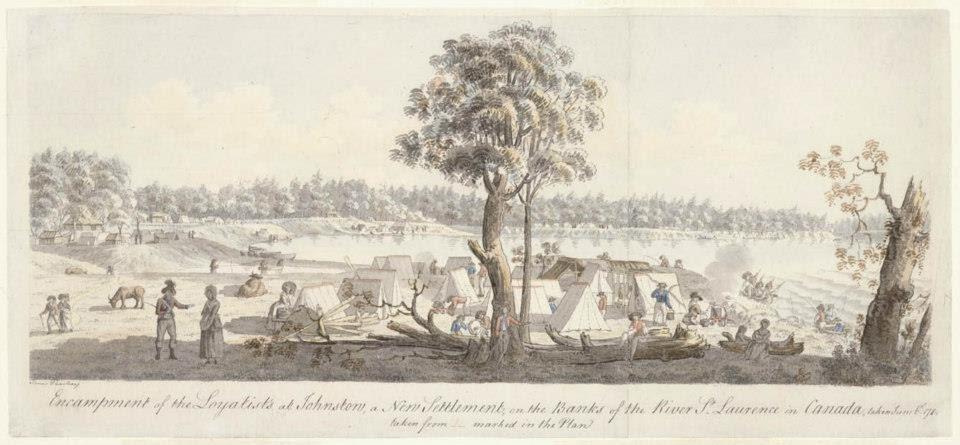
Loyalist Encampment at Johnson, Ontario 1784


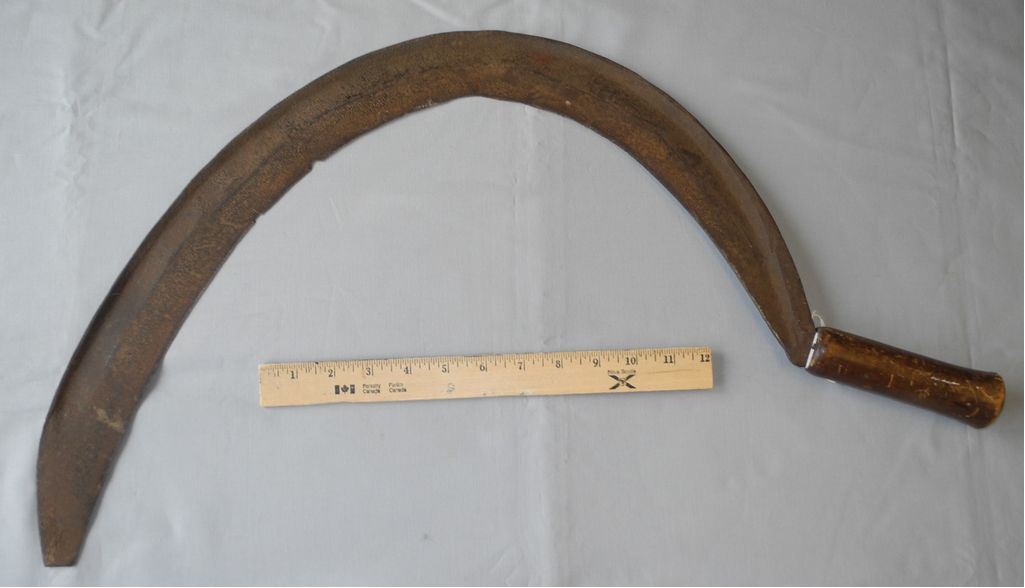
When the refugees left their camps, they proceeded to Sorel. Upon arrival, every loyalist was mustered and provisioned for their voyage to the new settlements on the Canadian frontier. Each man and boy over ten was issued a coat, waistcoat, breeches, hat, shirt, blanket, shoes and shoe soles, leggings, and stockings. Women and girls over ten received two yards of woolen cloth, four yards of linen, one pair of stockings, a blanket, and shoe soles, while small children qualified for one yard of woolen cloth, two yards of linen, stockings, and shoe soles. There was one blanket for every two children and five people were to share a tent and one cooking kettle. Farm tools, including grain sickles, were issued issued as well.


Surviving Grain Sickle issued to Loyalists by the British Government in 1783


From Sorel loyalists were ushered to Lachine for transportation to the west. Refugees were loaded onto batteaux specially constructed to traverse the rapids of the western St Lawrence River. The flat-bottomed bateaux ranged in size from twenty-five to forty feet long and accommodated four to five families and their belongings. Once the bateaux were loaded, they assembled in squadrons of twelve and set out, being powered variously by oars, poles, or sails. The trip was slow and trying. Rapids along the way forced the passengers and their belongings out of the batteaux, which had to be dragged and pulled with ropes through the churning waters. Winds, currents, and mosquitoes made the trip long and uncomfortable. At night the passengers had to sleep in make-shift tents or brush huts pitched by open fires used for cooking.

Life on the Canadian frontier was difficult at best. Money was scarce and markets for supplies were almost non-existent. By June 1784, Jessup reported that development of the settlement was behind schedule. However, a month later, Justus Sherwood asserted “that the people have got on their farms, are universally pleased, are emulating each other so that every lot in the front of the three townships and many of those in the back townships are improved and the country bears a very promising appearance.” By September, Jessup informed officials “the settlement is going on much better than he expected from the lateness of the season and the reduction of provisions. The allowance made by His Excellency made a great change and the people act with resolution and spirit, but it the allowance is discontinued they will be much distressed.”

By October 1784, the development of Second Town had progressed to the point Jessup reported the discovery of iron ore and proposed the construction of iron works, saw mills and corn mills. Seven months later, he reported the towns of his settlement had grown large enough to include over one thousand men, women and children.

That same year Second Town was renamed Ernestown in honor of King George’s fifth son Prince Ernest Augustus.

During the years before the War of 1812 Ernestown grew rapidly, partly because of its location at the mouth of the Bay of Quinte and partly because of its role as the supplier of foodstuffs to Kingston. Several decades later the historian William Canniff asserted that in the pre-war period Ernestown rivaled even Kingston itself, in respect to rapid increase of inhabitants, the establishment of trade, building of ships, and from the presence of gentlemen of refinement and education.

Friday, November 18, 2016

"In a Very Rusty Condition" - British Stands of Arms Issued to Massachusetts Provincial Soldiers During the French and Indian War

During the French and Indian War, Massachusetts Bay Colony encouraged its provincial soldiers to provide their own arms, rather than rely upon the government. For example, Governor Pownall declared in the Boston Gazette that “as most people in North America have arms of their own, which from their being accustomed to and being so much lighter than the Tower Arms, must be more agreeable and proper for them, General Amherst, as an encouragement for their coming provided with good muskets, engages to pay every one they shall so bring that may be spoiled or lost in actual service at the rate of twenty-five shillings sterling.” Jonathan Barnard of Waltham, Massachusetts petitioned the Massachusetts colony to be reimbursed for the loss of a firearm by his son who was killed “in a battle near Lake George”. This effort was met with moderate success and as a result, a shortage still existed. In turn, Massachusetts was forced to petition Britain for military supplies.

The arms shipped to Massachusetts were generally referred to as a “stand of arms”. Firearms were issued in complete sets or “stands”, meaning that all of the basic components and accouterments needed to use the firearm were included. These components included the firearm itself, a bayonet fitted to the gun, bayonet scabbard, sling, a belly box with a waist belt and leather frog. Unlike the better quality cartridge boxes issued to regular regiments, the belly boxes that came with the stands were simple wooden blocks with cartridge holes drilled in it. Two thin leather strips were nailed to the front of the box for a waist belt, which carried the frog, scabbard and bayonet.

It appears that the number of rounds a cartridge box could hold varied from box to box. In a letter of Henry Bouquet to Forbes, dated June 14, 1758, the author notes, “I have noticed a great inconvenience in the use of cartridge boxes for the provincial troops. They do not know how to make cartridges, or rather, they take too much time. In the woods, they seldom have time or places suitable to make them. These cartridge boxes hold only 9 charges, some twelve, which is not sufficient. I think that their powder horns and pouches would be more useful, keeping the cartridge box, however, to use in case of a sudden or night attack.”

Artifacts recovered from the British man-of-war Invincible, wrecked in the Solent while sailing for the invasion of Louisbourg in 1758, also provide detailed information about cartridge boxes. Among the items recovered in 1979 was a nine-hole belly box with part of the leather flap still intact. In the “General Orders of 1757 Issued by the Earl of Loudoun and Phineas Lyman in the Campaign Against the French”, the orders indicate effective “July 2d, 1757, at Fort Edward, that Each Man be provided with 24 Rounds of Powder & Ball.”

Bayonets recovered from fortifications manned by Massachusetts provincial troops suggest the bayonets issued consisted of flat bladed socket bayonets manufactured in England between 1700 and 1730. At other archeological sites in the Lake Champlain region, it appears Massachusetts provincial soldiers were also issued Dutch rectangular bladed bayonets manufactured in the 1720s.


Massachusetts soldiers received powder horns, powder flasks, knapsacks and bullet pouches. An inventory of equipment provided by the government to Massachusetts troops participating in the 1755 Crown Point expedition suggests the following equipment was distributed “1200 cartouch boxes . . . 1500 powder flasks … 1300 powder horns … 1500 worms & 1500 wires . . . 1500 knapsacks and bullet pouches.”

Naturally, one must ask what type of musket was issued as part of the stand of arms. In the fall of 1755, then Governor Shirley described the 2000 stands of arms he received to include “ Land muskets of the King’s pattern with double bridle locks, old pattern nosebands and wood rammers.” In the spring of 1756, 10,000 stands of arms were shipped to the colonies, including Massachusetts. The shipment consisted entirely of “Land service muskets of the King’s pattern with brass furniture, double bridle locks, wood rammers with bayonets & scabbards and tann’d leather slings.” The descriptions of these muskets, particularly with the emphasis on “double bridle locks”, suggest the muskets issued to Massachusetts provincial troops was the 1742 King’s Pattern (often and erroneously referred to as the 1st Model Brown Bess).

The 1742 King’s Pattern was the successor to the 1730 pattern and represented the majority of muskets shipped from England to Massachusetts during the French and Indian War. The 1742 musket’s overall length was 61 11/16 inches, its barrel length was 45 1/2 inches and its caliber was .77. This firelock featured a double bridled firelock, a wood ramrod, a brass nose band to slow wear on the fore end of the stock and a redesigned oval trigger lock. All furniture was brass.


However, the 1742 pattern was not the only type of musket delivered to Massachusetts. Because the British government could not always keep up with demand and wartime shortages, the colonies also received Dutch muskets produced between 1706 and 1730. Dutch muskets were generally 61 3/8 inches in length; its barrel was 45 7/8 inches and had a caliber of .78. Its furniture was composed of iron or brass, the ramrods were made of wood and the lock plate was rounded (as opposed to flat). As described above, the accompanying bayonets were short-shanked rectangular blades.

Unfortunately for Massachusetts Bay Colony, the muskets and related equipment supplied by the British government were not top of the line. On July 16, 1756, Colonel John Winslow and Lieutenant Colonel George Scott both complained that the arms they received “are in very bad condition.” That same year, Virginia’s Lieutenant Governor Robert Dinwiddie complained about a shipment of arms that was received and slated to be shared amongst the American colonies, including Massachusetts. According to Dinwiddie, the stands of arms were “in a very rusty condition, and it w’d appear they had been under water for months.” The previous year, on September 28, 1755, Governor Shirley and Major General William Pepperrell both received correspondence highlighting the inadequacies of weapons and equipment sent to Massachusetts provincials. “The locks being wore out and the hammers so soft, that notwithstanding repeated repairs they are most unfit for service, particularly Sir William Pepperrell’s Regiment being old Dutch arms. The holes of the pouches and boxes are so small that they cannot receive the Cartridge, nor is there substance of the wood, to widen them sufficiently. The leather scanty and bad likewise.”

Of course, in the eyes of the British government, the stands of arms provided to Massachusetts soldiers were property of His Majesty and were expected to be returned to officials at the end of each campaign. Yet despite the existing deficiencies, Massachusetts soldiers often refused to return these stands of arms. In 1757, the British Comptroller Furnis complained “out of the 2,000 [stands of arms] issued to the Province of the Massachusetts Bay, he has just yet received 300 only.” Two years later, Governor Pownall complained “I had caused about three thousand stand of arms to be delivered to the men, raised the last year for His Majesty’s service, under General Abercromby; I have an account of one hundred and fifteen only, as yet returned.”

Assuming the numbers are accurate, at least 4585 British and Dutch muskets, belly boxes and bayonets remained in the hands of the Massachusetts provincials by 1759. Thus, it is highly plausible that many of these muskets, especially the 1742 King’s Pattern, were utilized by Massachusetts militia and minute companies on April 19, 1775 and during the subsequent Siege of Boston.

Tuesday, November 15, 2016

"For Sale Cheap" - A Sample of Revolutionary War Era Merchant Advertisements from Northern Massachusetts

One of the more common misconceptions of colonial Massachusetts is the belief that residents who lived outside of major seaport communities were forced to make everything they wore, carried or utilized because they did not have access to imported goods.  This could not be further from the truth.  A casual review of period Massachusetts newspaper accounts reveals that merchants commonly set up shops in communities outside of Boston to sell their wares.

Below is a sample of advertisements that appeared in "The Essex Gazette" and were from merchants that operated in the interior of Massachusetts Bay Colony...specifically Haverhill, Andover and Amesbury.


Thursday, November 10, 2016

"The Art Military" - How a British Deserter was Recruited to Train Massachusetts Minute Men

As war loomed between Massachusetts and England, a strong emphasis was placed on military drilling and training by most of the towns in the colony.  Following the recommendations of the Massachusetts Provincial Congress, Andover ordered “[Soldiers] on the said first said day of December meet together and chuse such person only for leading or instructing as shall appear to them to be most skillful in Military Discipline and that they be well equipped with good guns, and other necessary warlike armour in order for their performing of all military maneuvers.”  Amesbury resolved that its minute men would engage in “exercising four hours in an fortnight.”  Two weeks later, the town modified its order and instructed its minute men to “[exercise] four hours in a week.”  The residents of Boxford voted on March 14, 1775 “that the minute-men shall train one half day in a week, for four weeks after this week is ended.”  The Reverend Jonas Clarke noted Lexington's militia was often drilling and "showing arms". Methuen simply ordered its minute company be “drawn out or exposed to train.”

Haverhill initially voted that its minute men “be duly disciplined in Squads three half days in a Week, three hours in each half day.”  On March 14, 1775, the town also voted to raise thirty dollars “to procure a military instructor to instruct the Militia in the Art Military.”  One week later, it was voted that the minute-men should train one whole day per week, instead of three half days as previously voted.  Furthermore, the minutemen were to be trained by a “Mr George Marsden, whom we have hired.”  

Interestingly, this is not the only record of a George Marsden being hired to train minute companies in the Merrimack Valley region of Massachusetts. A Haverhill “Independent Corps” commanded by Captain Brickett passed their own resolution “that we hire Mr George Marsdin for 4 days at 12s a day, & that he be paid out of the fines.” Similar records from Andover and Bradford Massachusetts also reference the hiring of George Marsden to train their minute companies.


So who was George Marsden?

Marsden was a grenadier from the 59th Regiment of Foot. He and his regiment arrived in New England in 1768. However, by 1769 the 59th was in Nova Scotia. A muster roll from October, 1770 reveals Marsden was promoted to the rank of sergeant. Unfortunately, by 1774 he was demoted back to a private. The reason for the demotion is unknown but the regimental muster rolls indicate that on July 24, 17774 he deserted from his regiment. Afterwards, Marsden fled to Haverhill.

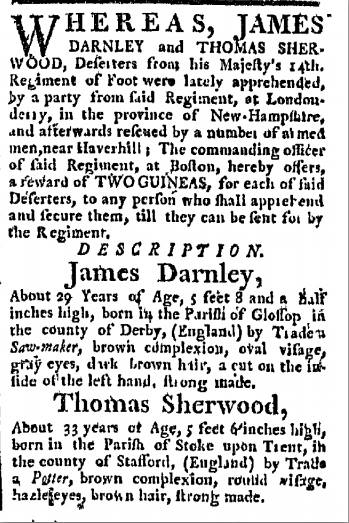
Haverhill was historically friendly to British deserters. For example, in 1773, armed residents attacked a party of British soldiers escorting deserters from the 14th Regiment of Foot back from Derry, New Hampshire to Boston. Afterwards, the two deserters successfully escaped.

Marsden was the logical choice to train the minute companies of Andover, Bradford and Haverhill. He was intelligent and had extensive experience with the British army. In March and April of 1775, the units actively worked with Marsden to prepare for war.

It is unknown if Marsden fielded with any of the minute companies he trained on April 19, 1775. On May 19, 1775, he appears on the muster roll of Colonel Scamman's Massachusetts Regiment. Marsden became the regimental adjutant and fought at the Battle of Bunker Hill. When he testified against his regimental commander at a court martial hearing, Marsden described his role in the engagement: "Adjutant Marsden was sworn at the desire of the complainants and deposed that we were three-quarters of an hour on the little hill and continued about twenty minutes after we heard of the firing on the hill in Charlestown. I went half-way up Bunker’s hill with Col. Scammans when I left him and went to the breastwork, where I got before the enemy forced it; the confusion was so great when we got to Bunker’s-Hill we could not form the regiment"

Later in the year Marsden became a lieutenant in Colonel William Prescott's Regiment. He married Wilmot Lee on November 25, 1775.

Tuesday, November 8, 2016

"A Most Shocking Picture of Havock and Wild Desolation" - The Hampshire Land Grants on the Eve of the Revolution

On the eve of the American Revolution, a dispute over land grants located in modern day western Vermont was being played out. Known as the “Hampshire Grants”, this region of the American colonies was the scene of continuous warfare and civil unrest.

The source of the land disputes could be traced back to the aftermath of King George’s War. In 1749, Governor Benning Wentworth of the Colony of New Hampshire asserted that New Hampshire’s south western boundary line met at the juncture of the Hudson and Mohawk Rivers. In turn, the governor permitted the sale of land grants in territories west of the Connecticut River. Many of these grants were sold to land speculators at £20 per grant.

Unfortunately for Wentworth, the Colony of New York also laid claim to the same region. New York asserted its southern border with Connecticut existed twenty miles east of the Hudson, while its border with New Hampshire was placed at the Connecticut River. As with New Hampshire, the Colony of New York also initiated the sale of land patents to speculators and wealthy colonists.

The Hampshire Grants was flooded with New Englanders, Scottish and Irish immigrants, New Yorkers and veteran soldiers all seeking new economic opportunities. Prominent loyalists, including Ebenezer Jessup, acquired large tracts of land within the territory. However, when settlers arrived they found conflicting titles to the same land held by other settlers. New York colonists were alarmed when they discovered New Hampshire settlers creating townships further and further westward, while New Hampshire colonists objected to encroachments by New Yorkers.

By September 1762, tensions between the two colonies rose when New York settlers apprehended New Hampshire surveyors examining potential land grants on the eastern shore of Lake Champlain. In response, Governor Wentworth issued a proclamation reestablishing his colony’s claim to the Hampshire Grants. New York immediately appealed to the Board of Trade, requesting a confirmation of their original land grant. Ultimately, the Board of Trade resolved the dispute in favor of New York. A royal order of July 26, 1764 established the Hampshire Grants as part of New York. By March, 1772, the Hampshire Grants was incorporated into the County of Charlotte.

However, this did little to alleviate tensions on the local level. New Hampshire settlers refused to recognize the authority of the rival colony while New York settlers quickly removed the “illegal” occupiers. As Captain John Montresor observed with some frustration “they declare that possession is Eleven points in the Law and that they will take advantage of these Disturbances and as no law prevails at present will support themselves.” Violence erupted and became so prevalent that British soldiers stationed at Crown Point were ordered into the Hampshire Grants to subdue both factions.


1777 Map of Charlotte County and Incorporated Hampshire Grants

By 1771, the population of the Hampshire Grants expanded significantly as a new wave of settlers, including Connecticut and New Jersey colonists, flooded into the territory. The growing population only rekindled disputes over land titles and sparked further confrontations. On June 11, 1771, over a dozen armed men, led by Robert Cochran and supported by New Hampshire grantees, forcibly removed a New York grantee from his 350 acres of land, attacked several of his neighbors and burned their homes. Governor William Tryon of New York warned authorities that unless the problem of conflicting land titles was resolved, “the daring insults of these people will in a short time lead to serious consequences.”

Almost two years later, on April 21, 1773, British soldiers under the command of Captain Anstruther accidentally set fire to a barracks chimney at Crown Point while making soap. The fire quickly spread and ignited the garrison’s magazine. After the resulting explosion, local New Englanders seized the opportunity, descended upon the fort and plundered it. Shortly thereafter, “New Hampshire Rioters” led by Ethan Allen embarked on a campaign of terror to drive out settlers with ties to New York. The stability of the region deteriorated to the point that many New York settlers abandoned plans to reside on designated land grants, New Englanders built block houses on the eastern shore of Lake Champlain, and British authorities deliberated as to whether or not a military expedition should be dispatched into the Hampshire Grants to quell the violence.

However, before stability could be restored to the region, the Revolutionary War began and the Hampshire Grants was thrown into even greater turmoil. Communities became sharply divided, competing militia and paramilitary organizations were raised, bloody skirmishes flared up and a mass evacuation of Charlotte County loyalists to Canada occurred. By 1777, much of the Hampshire Grants near Fort Edward and along the shores of Lake Champlain were “marked with Devastation, and of the many pleasant habitations ..., some were burnt, others torn to Pieces and rendered unfit for Use, and but a few of the meanest occupied: the Inhabitants in general having been forced to leave their once peaceful Dwellings to escape the Rage of War. Thus this once agreeable and delightful Part of the Country now displayed a most shocking Picture of Havock and wild Desolation.”

Unlike loyalists and patriots in other parts of New York and New England, allegiances to the crown or congress in the Hampshire Grants was often dictated by land claims and economic opportunity rather than social, cultural or religious principles. According to Paul R. Huey, contributing author of The Other New York: The American Revolution Beyond New York City 1763-1787, at the outset of the war, many inhabitants of the Hampshire Grants were more concerned with their respective land grants than the revolutionary crisis. Property owners in the Hampshire Grants had a strong desire to protect their property interests. In turn, these property interests guided whether or not one would maintain loyalty to the British government or support the revolutionary movement.